
The standard tip for waiters at full-service restaurants in the U.S. is now about 20% of your total bill. That number has shifted upward over the past decade. What was once a 15% baseline is now considered low by most diners and servers alike. Knowing how much to tip a waiter matters because gratuity makes up the majority of a server's income. A quick tip calculator or simple mental math can get you to the right number in seconds, and this guide covers both.
How much should you tip a waiter?
The appropriate tip for a waiter depends on the quality of service you received. The standard tipping range runs from 15% on the low end to 25% or more for exceptional service. Here is how to read the range:
- 15% or below: Below-average or slow service. Leaving 15% signals dissatisfaction without being rude. Anything under 10% sends a strong message, so use that only when service was genuinely poor.
- 18–20%: Good, attentive service at a casual or mid-range restaurant. This is the current social baseline most diners use.
- 20–25%: Great service, a complex order, or a busy shift where your server went above and beyond.
- 25% or more: Exceptional service, fine dining, or a large party where the server managed multiple needs flawlessly.
Tipping also works as feedback. A server who receives 12% on a table knows something went wrong. A server who consistently earns 22% knows they are doing the job well. That signal matters in an industry where performance reviews are rare.
Digital payment screens now default to suggested tips of 18%, 20%, and 22%. That shift reflects a higher social norm than the former 15% standard. When you tap the lowest option on a tablet, you are not being cheap by old standards. You are landing right at the floor of what is now considered acceptable.
Pro Tip: If your service was genuinely excellent, round up to the next clean dollar amount above 20%. On a $47 bill, that might mean tipping $10 instead of $9.40. Servers notice the difference, and it costs you very little.
How to calculate your tip without a calculator
The fastest method for calculating a tip is the 10% rule. Move the decimal point one place to the left on your bill total. That gives you 10%. Double it for 20%. On a $60 bill, 10% is $6, so 20% is $12. Done in five seconds.
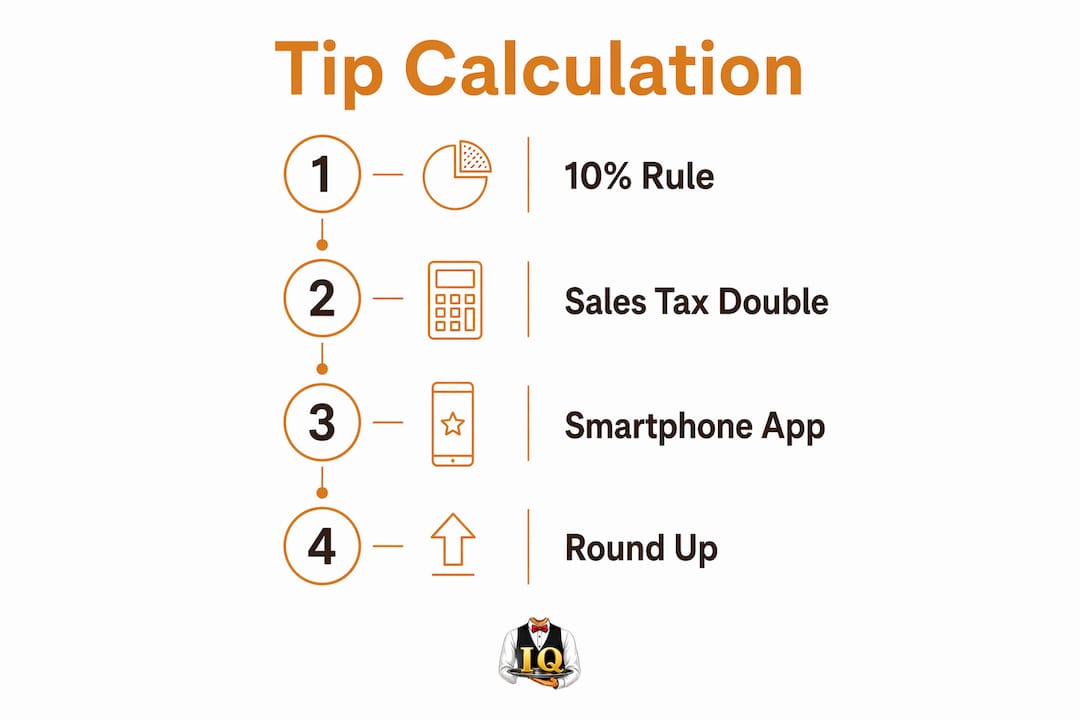
A second shortcut works well in cities with a high sales tax, like New York City. Double the sales tax line on your receipt. NYC's restaurant tax runs close to 9%, so doubling it lands you near 18%. It is not exact, but it gets you close without any math.
Here is a quick reference table for common bill amounts:
| Bill total | 15% tip | 18% tip | 20% tip | 25% tip |
|---|---|---|---|---|
| $25 | $3.75 | $4.50 | $5.00 | $6.25 |
| $50 | $7.50 | $9.00 | $10.00 | $12.50 |
| $75 | $11.25 | $13.50 | $15.00 | $18.75 |
| $100 | $15.00 | $18.00 | $20.00 | $25.00 |
| $150 | $22.50 | $27.00 | $30.00 | $37.50 |
One common question is whether to tip on the pre-tax or post-tax total. Tipping on the pre-tax amount is technically more precise. Tipping on the post-tax total is widely accepted and easier to calculate. Either approach is fine socially. The difference on a $60 bill in a state with 8% tax is less than a dollar.
- Look at your bill total.
- Move the decimal one place left to find 10%.
- Double that number for a 20% tip.
- Add half of the 10% figure if you want to tip 15% instead.
- Round up to the nearest dollar for simplicity.
Pro Tip: A tip calculator for restaurant bills is built into most smartphones. On iPhone, open the Calculator app, enter your bill total, tap the percent key, and type 20. The result is your tip amount.
How does tipping change for groups, buffets, and special cases?
Group dining, buffets, and discounted meals each follow slightly different rules. Getting these right prevents both undertipping and accidental double-tipping.

Large groups: Restaurants commonly add an automatic gratuity for parties of 6 to 8 or more. This charge usually runs 18–20% and appears as a line item on the bill. Check your receipt before adding an additional tip. Paying twice is a common mistake at group dinners.
Splitting the bill: When a group splits the check, calculate the tip on the full total first, then divide. Individual calculations often result in rounding shortfalls that leave the server underpaid. One person does the math on the whole bill, and everyone pays their share of that number.
Buffets: Buffet service is limited. Your server clears plates and refills drinks but does not take orders or run food. A 10–15% tip is standard for attentive buffet staff. At a low-service buffet where staff interaction is minimal, $1–$2 per person is also acceptable.
Gift cards and discounts: Always tip on the original bill total, not the discounted amount. If your $80 meal drops to $50 after a gift card, your server still did $80 worth of work. Tipping on the pre-discount total is the fair approach and the one most servers expect.
| Dining situation | Recommended tip |
|---|---|
| Full-service restaurant | 18–20% of total bill |
| Fine dining | 20–25% |
| Buffet | 10–15%, or $1–$2 per person |
| Large group (auto-gratuity added) | Check bill; add extra only for exceptional service |
| Discounted meal or gift card | Tip on original pre-discount total |
Common tipping mistakes and how to avoid them
Most tipping errors come from misunderstanding how the system works, not from bad intentions. These are the situations where diners most often get it wrong.
- Tipping zero for bad food: Poor food quality is a kitchen issue, not a server issue. Leaving no tip punishes the wrong person. Speak with the manager about food problems and still tip your server for their service.
- Not accounting for tip-out: Servers share their tips with support staff including food runners, hosts, and bartenders. Low tips can create a net loss for a server after tip-out requirements are met. A 10% tip on a $100 table might leave a server with $6 after sharing.
- Leaving no tip for truly poor service: Even for genuinely bad service, an etiquette-appropriate tip of 10–15% is standard unless the server was hostile or rude. Leaving nothing is often misread as forgetting rather than sending a message.
- Cash vs. card tips: Tips paid by card may be distributed more broadly among staff before your server receives them. Cash tips typically go directly to the server that night. If you want your tip to reach your waiter immediately, cash is the more direct route.
- Tipping on a comped item: If a manager comps a dish or drink, tip as if you paid for it. Your server still served it.
"Tipping is not just a transaction. It is the primary way diners communicate the value of service in a system built on that exchange."
New tipping norms also now expect tips at counter-service locations, though that remains optional. Full-service restaurant tipping is not optional in the same social sense. It is the expected part of the meal cost.
Key takeaways
The standard tip for waiters at full-service restaurants in the U.S. is 20%, with 18% as the floor for good service and 25% or more for exceptional experiences.
| Point | Details |
|---|---|
| Standard tip percentage | Tip 18–20% for good service; 25% or more for exceptional service at full-service restaurants. |
| Quick calculation method | Move the decimal left for 10%, then double it to reach a 20% tip fast. |
| Group dining rule | Calculate tip on the full group total first, then split to avoid shortfalls. |
| Buffet and discount tipping | Tip 10–15% at buffets; always tip on the original total when using gift cards or discounts. |
| Tip-out awareness | Servers share tips with support staff, so tipping below 15% can cost a server money after sharing. |
Tipping is a choice, but it is also a responsibility
I have spent years talking with servers and watching how tipping plays out across different dining situations. The thing most diners do not realize is how thin the margin is. A server working a four-table section on a slow Tuesday night might walk out with $40 after tip-out. That is not a living wage. It is a gap that your tip fills.
The 20% standard is not arbitrary. It reflects the actual cost of running a tipped service model in 2026. Wages for tipped workers in most states are still set well below the standard minimum wage, with the expectation that tips cover the difference. When you tip 12% because the food took too long, you are likely penalizing someone who had no control over the kitchen.
The most common mistake I see is conflating the meal experience with the server's performance. A cold steak is a kitchen failure. A 20-minute wait for a table is a management failure. Your server's tip should reflect what your server actually did. Did they check in without hovering? Did they get your order right? Did they handle a problem with grace? That is what the tip measures.
One more thing: cash tips still matter. Card tips go through payroll in many restaurants, which means taxes, delays, and sometimes pooling arrangements the server did not choose. Leaving $5 in cash on a card-paid bill is a small gesture that lands directly in someone's pocket that night.
— sadler
Serveriq helps servers track every dollar they earn
Knowing how much to tip a waiter is one side of the equation. The other side belongs to the server counting that money at the end of a shift. Serveriq is a tip and earnings tracker built specifically for servers and bartenders, available for $3 per month.
Serveriq lets servers log daily tips, hourly pay, hours worked, and shift notes all in one place. Weekly and monthly reports show which shifts earn the most, so servers can make better scheduling decisions. The built-in assistant Chip lets users update earnings just by typing what happened. If you work in the restaurant industry and want to know exactly what you are making, Serveriq gives you that clarity without the spreadsheet headache. See the subscription options and get started for less than a cup of coffee per month.
FAQ
What is the standard tip percentage for waiters in 2026?
The standard tip for waiters at full-service restaurants is 20% for good service. The acceptable range runs from 18% to 22%, with 15% now considered low.
Should I tip on the pre-tax or post-tax amount?
Tipping on the pre-tax amount is technically more precise, but tipping on the post-tax total is widely accepted. The dollar difference is small and either approach is socially fine.
What should I tip at a buffet?
Tip 10–15% at a buffet where staff clear plates and refill drinks. At a minimal-service buffet, $1–$2 per person is also acceptable.
How do I avoid double-tipping at a group dinner?
Check your bill for an automatic gratuity line before adding a tip. Restaurants commonly add 18–20% for parties of 6 or more, and adding another tip on top is a frequent mistake.
Is it ever acceptable to leave no tip?
Leaving no tip is generally discouraged even for poor service. A 10–15% tip is the etiquette-appropriate floor unless service was genuinely hostile. For food or kitchen issues, speak with the manager rather than reducing the server's tip.