
Take-home tips are defined as the net earnings a server keeps from tip income after subtracting tip-outs to support staff and all applicable tax withholdings. Knowing how to calculate take home tips is not optional for restaurant workers. It is the foundation of accurate budgeting, legal tax compliance, and understanding your real hourly value. Gross pay includes both base wages and all reported tip income, regardless of whether tips came in cash or on a credit card. This guide walks through every step, from counting your first dollar to understanding what the IRS expects from you in 2026.
How to calculate take home tips: start with your gross tip income
Your gross tip income is the total of every tip you received during a shift before any deductions. That number comes from two sources: cash tips handed directly to you and credit card tips processed through the point-of-sale system. Both count equally toward your taxable income.
The IRS draws a clear legal line between voluntary tips and mandatory service charges. Service charges imposed by the restaurant are not considered tips and do not qualify for tip tax treatment or tip pooling. A 20% gratuity automatically added to a large party check is a service charge, not a tip. Only the money a guest chooses to leave qualifies as a tip under federal tax law.

Tracking every dollar matters because the IRS requires you to report tips to your employer. Employees must report tips of $20 or more per month by the 10th of the following month. Failing to report accurately creates a paper trail problem that can trigger audits and penalties.
Here is what to record daily to build an accurate gross tip total:
- Cash tips received per table or shift
- Credit card tips shown on your end-of-shift report
- Tips received through digital payment apps if your restaurant uses them
- Any tip pool distributions you received from other staff
Pro Tip: Keep a daily tip log in a notebook or app. The IRS recommends this practice, and it takes less than two minutes at the end of every shift. That record protects you if your employer's payroll ever shows a discrepancy.
How do tip-outs affect your net tips?
Tip-outs are the portions of your tips you share with other staff members, typically bartenders, busses, food runners, and hosts. The standard formula for net tips is straightforward: total tips earned minus total tip-outs equals the net tips you actually keep. That net number is what feeds into your take-home pay calculation.
Tip-out percentages vary by restaurant and role. Most houses calculate tip-outs as a percentage of your total sales, not your total tips. That distinction matters because your tip-out obligation stays the same even on a night when guests tip poorly.
The table below shows typical tip-out percentages by support role. These are industry averages and your restaurant's policy may differ.
| Support role | Typical tip-out range (% of server's total sales) |
|---|---|
| Bartender | 1%–2% |
| Busser | 1%–2% |
| Food runner | 1%–2% |
| Host | 0.5%–1% |
| Total tip-out | 3.5%–7% |
Here is a concrete example. You run $2,000 in sales on a Friday night and collect $380 in total tips. Your restaurant requires a 5% tip-out on total sales, which equals $100. Your net tips kept are $280. That $280 is the number you carry forward into your tax calculation, not $380.
Understanding this step prevents a common mistake: servers who calculate taxes on their gross tips end up confused when their paycheck does not match their expectations. The net tip figure after tip-outs is your real starting point.
What taxes come out of your tip income?
Tax withholdings on tip income follow two separate tracks: FICA taxes and federal income tax. Both apply to your reported tip income, but they work differently in 2026.
FICA is non-negotiable. The federal FICA tax rate for tipped employees in 2026 is 7.65%, split into 6.2% for Social Security up to a $184,500 wage base and 1.45% for Medicare with no income cap. Every dollar of tip income you report is subject to this combined rate. There are no exclusions, no thresholds, and no exceptions for FICA.
Federal income tax in 2026 works differently because of new legislation. Under the 2026 One Big Beautiful Bill Act, tip income up to $25,000 may be excluded from federal income tax. That exclusion does not eliminate FICA. It only reduces the amount of your tips subject to federal income tax brackets. The 2026 standard deduction further reduces your federal taxable income before brackets apply, which benefits most servers filing individually.
State and local taxes add another layer. Some states have no income tax, while others apply rates that meaningfully reduce take-home pay. You need to know your state's rate to complete an accurate net earnings calculation.
Key tax obligations to track every pay period:
- FICA (Social Security): 6.2% on all tip income up to $184,500
- FICA (Medicare): 1.45% on all tip income with no cap
- Federal income tax: Applied after the $25,000 tip exclusion and standard deduction
- State income tax: Varies by state; check your state's current rate
- Local income tax: Applies in some cities and counties
Pro Tip: Ask your employer how tip income is reported on your W-2. Box 1 shows wages and reported tips combined. Box 8 may show allocated tips if your reported tips fall below the IRS minimum threshold. Knowing this before tax season saves hours of confusion.
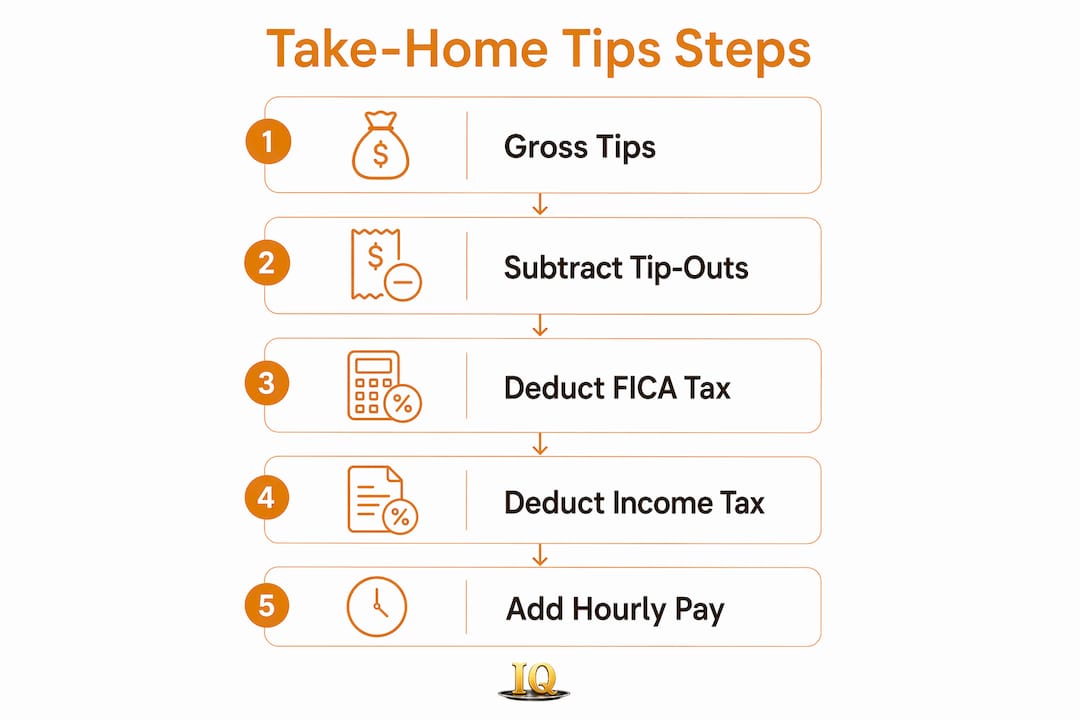
Step-by-step formula for your take-home tip calculation
The take-home pay formula for servers follows a clear sequence. Work through each step in order and you will land on an accurate net earnings number.
- Add all tips earned. Combine cash tips and credit card tips for the pay period. This is your gross tip income.
- Subtract tip-outs. Deduct the total amount paid out to bartenders, bussers, runners, and hosts. The result is your net tips kept.
- Add your hourly wages. Combine net tips with your base hourly pay for the period. This gives you gross taxable income.
- Apply the FICA rate. Multiply gross taxable income by 7.65% to find your FICA obligation for the period.
- Apply federal income tax. Subtract the $25,000 annual tip exclusion (prorated per pay period) and the standard deduction, then apply your federal bracket rate to the remainder.
- Subtract state and local taxes. Apply your state rate to gross taxable income after applicable deductions.
- Subtract any other deductions. Health insurance premiums, retirement contributions, or other voluntary deductions come out here.
- The result is your take-home pay. This is the net amount deposited or paid to you.
The table below shows how tip-outs and taxes change the final number using a real-world example based on a single pay period with $800 in gross tips and $1,200 in total sales.
| Calculation stage | Without tip-outs or taxes | With tip-outs and taxes |
|---|---|---|
| Gross tips | $800 | $800 |
| After tip-outs (5% of $1,200 sales) | $800 | $740 |
| Plus hourly wages ($10/hr x 40 hrs) | $1,200 | $1,200 |
| Gross taxable income | $2,000 | $1,940 |
| FICA (7.65%) | $0 applied | $148.41 |
| Federal income tax (estimated) | $0 applied | $87.00 |
| State income tax (estimated 5%) | $0 applied | $97.00 |
| Estimated take-home pay | $2,000 | $1,607.59 |
The gap between $2,000 and $1,607.59 is not a surprise if you run this calculation before payday. It becomes a surprise only when you skip the math.
Common mistakes servers make when calculating take-home tips
Underreporting tips is the most costly mistake a server can make. Failing to report tips accurately can lead to compliance issues and IRS penalties. The IRS cross-references employer-reported sales data against employee tip reports. A pattern of low reported tips relative to sales is a red flag that triggers audits.
Confusing service charges with tips is another frequent error. A mandatory 18% added to a party of eight is restaurant revenue, not your tip. Treating it as a tip inflates your reported income incorrectly and creates tax miscalculations.
Skipping daily records is the habit that causes the most long-term damage. IRS Publication 1244 outlines the recordkeeping requirements for daily tip income reporting. A daily log takes two minutes and creates a defensible record if the IRS ever questions your returns.
"Consistent recordkeeping is critical for lawful tip taxation. Servers who track daily are the ones who never face surprises at tax time."
Pro Tip: Use an app like Serveriq to log tips, hours, and tip-outs at the end of every shift. Automated tracking removes the mental load and gives you weekly and monthly summaries that make tax prep straightforward.
Key takeaways
Accurate take-home tip calculation requires subtracting tip-outs from gross tips, adding hourly wages, and applying FICA, federal, and state taxes in the correct order.
| Point | Details |
|---|---|
| Gross tip income | Add all cash and credit card tips before any deductions to find your starting number. |
| Net tips after tip-outs | Subtract tip-outs based on your restaurant's sales percentage policy before calculating taxes. |
| FICA applies to all tips | The 7.65% FICA rate applies to every reported tip dollar with no exclusions or thresholds. |
| 2026 federal income tax exclusion | Tip income up to $25,000 may be excluded from federal income tax under the One Big Beautiful Bill Act. |
| Daily recordkeeping | Log tips every shift using IRS Publication 1244 guidelines or a tracking app to stay compliant. |
Why I think most servers leave money on the table without realizing it
The uncomfortable truth I have seen repeated across the restaurant industry is that most servers have no real idea what their effective hourly rate is. They know their shift was good or bad based on feel, not math. That gap between perception and reality is where financial stress lives.
The servers who manage their money well are not necessarily the ones earning the most. They are the ones who run the numbers. They know their average tip percentage, their typical tip-out obligation, and roughly what their FICA bill will look like each month. That knowledge lets them plan for slow weeks in january and february instead of scrambling.
Payroll departments are not your financial advisors. They process what is reported to them. If your employer allocates tips on your W-2 because your reported tips fell below the IRS threshold, that is a problem you created by not tracking daily. The IRS does not accept "I forgot" as a defense.
The 2026 federal income tax exclusion on tips up to $25,000 is genuinely good news for servers earning in that range. But it only benefits you if you are reporting accurately in the first place. Servers who underreport lose the protection of that exclusion and face penalties on top.
My advice is simple. Treat your tip income like a small business treats its revenue. Track it daily, calculate your net pay weekly, and review your tax obligations monthly. The math is not complicated. The habit is what most people skip.
— sadler
Serveriq makes tip tracking simple for every shift
Restaurant workers who want to know their real take-home pay need more than a formula. They need a system that works every night after a long shift.
Serveriq is built for servers and bartenders who want to track daily tips, hourly pay, tip-outs, and shift notes all in one place. At $3 per month, it gives you weekly and monthly reports showing your best and worst earning days. Chip, the built-in virtual assistant, lets you log a shift just by telling him what happened. No spreadsheets, no guesswork, and no tax-season panic. Visit the Serveriq subscription page to get started, or learn more about the full platform at Serveriq.
FAQ
What is the formula for take-home tips?
Take-home tips equal your gross tips minus tip-outs, minus FICA taxes, minus federal and state income taxes. Add your hourly wages to get your full take-home pay for the period.
Do I pay FICA taxes on all my tips?
Yes. The 7.65% FICA rate applies to every dollar of reported tip income with no exclusions. The 2026 federal income tax exclusion does not reduce your FICA obligation.
How much of my tips do I have to report to the IRS?
You must report tips of $20 or more per month to your employer by the 10th of the following month. The IRS encourages daily recordkeeping using IRS Publication 1244 for full compliance.
Are service charges the same as tips for tax purposes?
No. Mandatory service charges added by the restaurant are not tips and do not qualify for tip tax treatment. Only voluntary gratuities left by the guest count as tips under IRS rules.
How does the 2026 tip tax exclusion affect my take-home pay?
Under the 2026 One Big Beautiful Bill Act, tip income up to $25,000 may be excluded from federal income tax. FICA taxes still apply in full, so your net savings depend on your federal income tax bracket.