
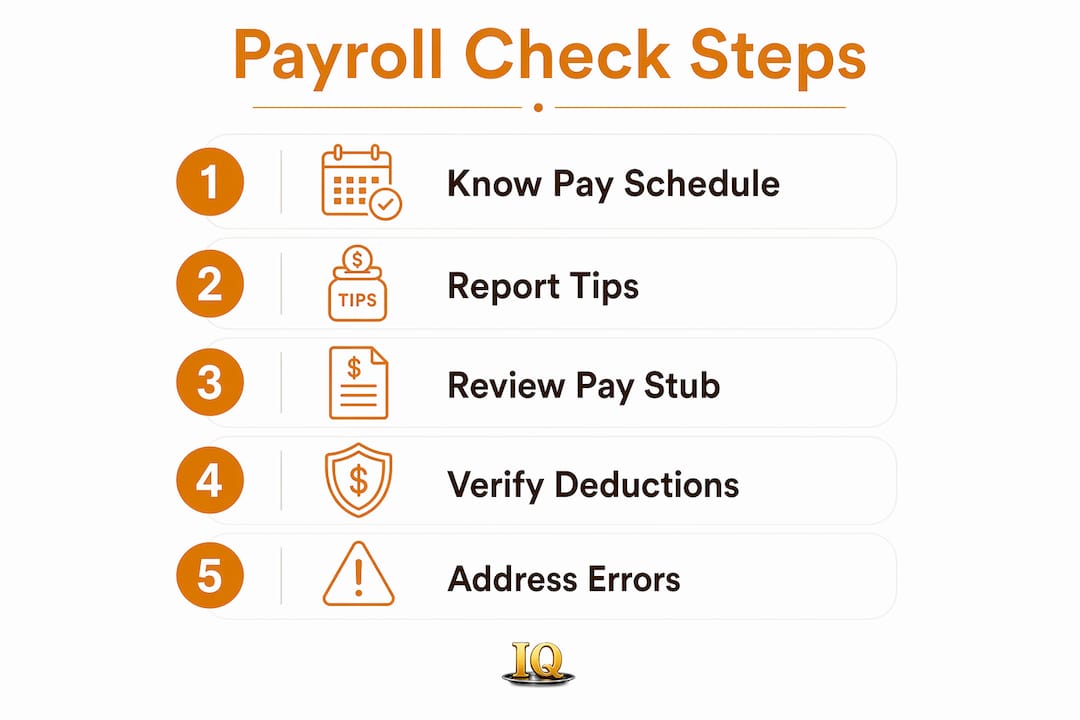
Restaurant payroll is defined as the process by which employers calculate and distribute wages, tips, and deductions to staff on a set schedule. For servers and bartenders, understanding restaurant payroll when you get paid and what to check is the difference between catching a $200 error and missing it entirely. Most restaurants pay on a weekly or bi-weekly schedule, and the IRS requires tip reporting by the 10th of the month following the tipping period. Knowing your pay schedule, tip reporting deadlines, and what every line on your pay stub means puts you in control of your own money.
What are common restaurant payroll schedules and when do employees get paid?
The hospitality industry pays restaurant employees most often on a weekly or bi-weekly basis. Weekly pay means a check every 7 days. Bi-weekly means every 14 days, which is 26 paychecks per year. Semi-monthly schedules cut that to 24 checks per year, paid on fixed dates like the 1st and 15th. Monthly pay exists but is rare for hourly restaurant workers.

State law controls how often your employer must pay you. Some states require weekly pay for hourly workers. Others allow bi-weekly or semi-monthly. Your employer must post the pay schedule where you can see it. If they change it, they must give advance notice.
The pay period and the pay date are not the same thing. Your pay period might end on sunday, but your check might not arrive until the following friday. That gap is normal. The problem comes when new hires hit the payroll lag effect, where delays in setting up tax IDs like an EIN or SUTA registration push back the first paycheck by a week or more.
- Weekly pay: Best for cash flow. Common in high-volume restaurants.
- Bi-weekly pay: Most common overall. Covers two full workweeks per check.
- Semi-monthly pay: Fixed dates, but can split a workweek across two pay periods.
- Monthly pay: Rare for tipped staff. Creates cash flow problems for most servers.
Pro Tip: Ask your manager for the exact pay period end date and pay date before your first shift. Knowing the schedule prevents the shock of waiting three weeks for your first check.
How and when should restaurant employees report tips?
The IRS requires you to report all cash tips to your employer by the 10th day of the month following the month you earned them. That means tips earned in january must be reported by february 10th. This deadline is not optional. Missing it can cause your employer to withhold the wrong amount of tax, which creates problems at tax time.
Tips are legally classified as wages. That means they are subject to FICA, Medicare, and federal income tax withholding, just like your hourly rate. Your employer withholds these taxes from your paycheck based on the tips you declare. The more accurately you report, the more accurate your withholding will be.
The standard form for reporting tips to your employer is IRS Form 4070. Many restaurants use their own internal reporting system, but the legal requirement is the same. You report, your employer withholds, and both of you stay compliant.
Not all gratuities work the same way. Here is how the main categories differ:
- Cash tips are money customers hand you directly. You report these yourself.
- Credit card tips are tracked by the POS system and usually appear on your pay stub automatically.
- Tip pool distributions are shared amounts from a collective pool. These are still wages and still taxable.
- Mandatory service charges are not tips. They are wages the restaurant collects and distributes. They are subject to withholding from the moment they are paid out. Service charges are legally wages, not gratuities, which changes how your taxes are calculated.
One rule that surprises many servers: managers cannot legally keep any portion of a tip pool. If your manager is taking a cut of the tip pool, that is a labor law violation. Report it to your state labor board.
Pro Tip: Keep a daily tip log in a notebook or app. Record cash tips at the end of every shift. This protects you if your employer's POS records differ from what you actually earned.
What details should employees check on their restaurant pay stubs?
Your pay stub is your proof of payment and your first line of defense against payroll errors. Every server should read it line by line, not just glance at the net pay number.
Gross wages and overtime
Gross wages are your total earnings before any deductions. This includes your base hourly rate multiplied by hours worked, plus any overtime. Federal overtime rules require that overtime be calculated on each individual 7-day workweek, not averaged across a bi-weekly pay period. If you worked 45 hours one week and 35 the next, you are owed 5 hours of overtime for week one, even if the two-week total averages out to 40 hours per week.
Declared tips and tip credit
Your pay stub should show the tips you declared. If your employer uses a tip credit, your base hourly wage may be as low as $2.13 per hour federally. The tip credit closes the gap between that base rate and the federal minimum wage of $7.25 per hour. If your tips do not cover that gap, your employer must make up the difference in cash. Check that your gross pay reflects this correctly.
Deductions to verify
Pay stub deduction codes often confuse employees because taxes are withheld on both your base wages and your declared tips. Here is what to look for:
- Federal income tax: Withheld based on your W-4 filing status.
- FICA (Social Security): 6.2% of your gross wages including tips.
- Medicare: 1.45% of your gross wages including tips.
- State income tax: Varies by state. Some states have none.
- Tip pool deductions: Should match what you agreed to contribute.
- Service charge distributions: Taxed as wages, not tips.
| Pay stub line | What it means | What to check |
|---|---|---|
| Gross wages | Total pay before deductions | Hours worked × hourly rate + overtime |
| Declared tips | Tips you reported to employer | Matches your personal tip log |
| Tip credit | Employer's wage offset using your tips | Total pay still meets minimum wage |
| FICA/Medicare | Payroll taxes on wages and tips | Calculated on full gross including tips |
| Net pay | Take-home amount after all deductions | Cross-check against your own records |
What are best practices for tracking earnings and avoiding payroll mistakes?
Keeping your own records is the single most effective way to catch payroll errors before they compound. Relying only on your employer's POS or payroll system is a common mistake with real financial consequences. Your records and your employer's records should match. When they do not, you have documentation to back your case.
Here is what to track after every shift:
- Hours worked: Start time, end time, and any breaks taken.
- Cash tips received: Exact amount, logged before you leave the building.
- Credit card tips: Note the amount shown on your receipts or POS printout.
- Tip pool contributions and distributions: What you put in and what you got back.
- Any shift differentials: Holiday pay, event pay, or special rate shifts.
When your paycheck arrives, compare it against your personal log. Check that your hours match. Check that your declared tips match. Check that overtime was calculated correctly on each individual workweek, not blended across the pay period.
If you find a discrepancy, address it immediately. Bring your personal records to your manager or payroll contact. Most honest errors get corrected quickly when you have documentation. Waiting weeks to raise the issue makes resolution harder.
Pro Tip: Log your shift details the same night you work. Memory fades fast. A quick note on your phone or in a tracking app takes 60 seconds and saves hours of frustration later.
How do minimum wage laws and tip credits affect your paycheck?
Federal law sets the minimum total compensation at $7.25 per hour for tipped employees, combining base wage and tips. Employers can pay a base wage as low as $2.13 per hour if tips make up the difference. If they do not, the employer must top off your pay to reach the minimum. This is called the tip credit, and it directly affects how much base pay appears on your stub.
Many states set a higher minimum wage than the federal floor. Florida's minimum wage, for example, is $13.00 per hour. In those states, the tip credit calculation changes, and your total pay must meet the state minimum, not just the federal one. Always check your state's current rate.
| Wage type | Federal rate | What it means for your check |
|---|---|---|
| Federal minimum wage | $7.25/hr | Floor for total wage plus tips combined |
| Federal tip credit max | $5.12/hr | Maximum employer can deduct from base wage |
| Minimum base wage (federal) | $2.13/hr | Lowest legal base rate for tipped workers |
| State minimum (example: Florida) | $13.00/hr | Overrides federal if higher; tips must close the gap |
A common payroll error is an employer applying the tip credit without verifying that your tips actually covered it. If you had a slow week and your tips fell short, your gross pay must still meet the applicable minimum wage. Check the math yourself.
Key Takeaways
Restaurant payroll accuracy depends on servers knowing their pay schedule, reporting tips on time, and verifying every line of their pay stub against personal records.
| Point | Details |
|---|---|
| Know your pay schedule | Most restaurants pay weekly or bi-weekly; confirm your pay period end date and pay date before your first shift. |
| Report tips by the 10th | The IRS requires tip reporting by the 10th of the following month; late reporting causes tax withholding errors. |
| Verify overtime correctly | Overtime is calculated per 7-day workweek, not averaged across a bi-weekly pay period. |
| Check tip credit math | If your tips did not meet the minimum wage threshold, your employer must make up the difference in your paycheck. |
| Keep your own records | A personal log of hours and tips is your best tool for catching and correcting payroll discrepancies. |
What I have learned watching servers get shortchanged
Working in and around the restaurant industry for years, the payroll mistake I see most often is not fraud. It is silence. A server notices their check looks low, assumes they miscounted, and says nothing. Two weeks later it happens again. By the time they say something, they have lost real money.
The servers who never get shortchanged are the ones who treat their tip log like a second paycheck. They write down every shift. They check their stub the day it arrives. They know their overtime rules cold. When something is off, they walk into the manager's office with a printed log and a specific dollar amount. That conversation is short and almost always ends in a correction.
The other thing I have seen trip people up is the service charge confusion. A restaurant adds a 20% service charge to large parties. The server assumes that is their tip. It is not. It is a wage, taxed differently, and sometimes distributed differently than a standard tip. Read your pay stub to see how it was coded. If it shows up as a service charge distribution rather than a tip, the tax treatment is different and your net pay will reflect that.
You do not need an accounting degree to protect your own paycheck. You need a log, a few minutes after each shift, and the confidence to ask questions when the numbers do not add up.
— sadler
Serveriq makes payroll tracking simple for servers
Keeping a personal earnings log is the most effective habit a server can build, and Serveriq makes it the easiest part of your day.
For $3 per month, Serveriq tracks your daily tips, hourly pay, hours worked, holiday pay, event pay, and shift notes all in one place. Weekly and monthly reports show your best and worst earning days so you can spot patterns and catch discrepancies before payday. Chip, Serveriq's built-in virtual assistant, lets you log a shift or update your earnings just by telling him what happened. Built by servers for servers, Serveriq gives you the records you need to verify every paycheck with confidence. Check out the subscription details and start tracking tonight.
FAQ
How often do restaurants pay their employees?
Most restaurants pay employees weekly or bi-weekly. State law determines the minimum pay frequency, and employers must post their schedule where staff can see it.
When do I have to report my tips to my employer?
The IRS requires you to report all cash tips to your employer by the 10th day of the month following the month you earned them. Use IRS Form 4070 or your employer's internal reporting system.
What is the tip credit and how does it affect my paycheck?
The tip credit allows employers to pay a base wage as low as $2.13 per hour federally, with tips making up the difference to the $7.25 minimum wage. If your tips fall short, your employer must pay the gap.
Can my manager take a share of the tip pool?
No. Federal labor law prohibits managers from keeping any portion of a tip pool. If your manager is taking a cut, that is a legal violation you can report to your state labor board.
Why was my first paycheck delayed?
New hires often experience a payroll lag because employers must complete tax registrations like EIN and SUTA setup before processing payroll. This can push the first paycheck back by one to two weeks.