
Restaurant rush hour is defined as the peak service window when order volume, guest demands, and team coordination all spike at once. For servers and bartenders, tips for handling rush hour without mistakes are not optional skills. They are the difference between a profitable shift and a chaotic one. Peak rush hours typically fall during weekday lunch (11:30 a.m. to 1:30 p.m.) and dinner (5:30 p.m. to 8:00 p.m.), with error rates rising 40–50% compared to off-peak periods. That spike happens because multitasking demands overwhelm working memory. The good news is that preparation, task management, and communication can bring those error rates back down significantly.
What preparation steps should restaurant staff take before a rush hour shift?
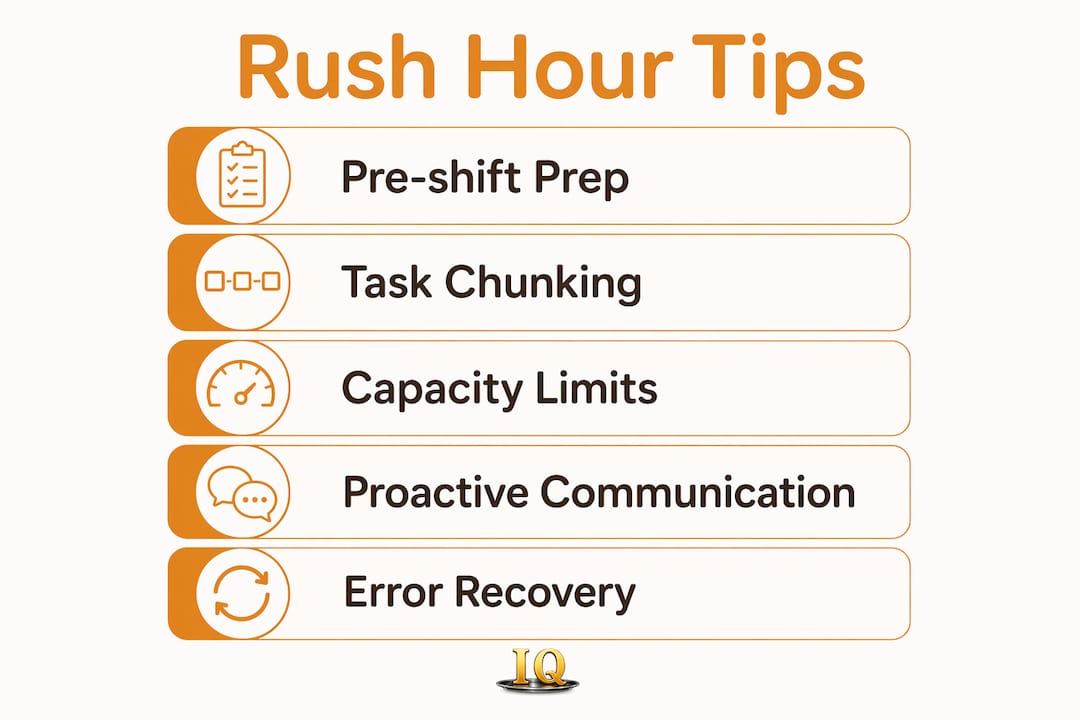
Pre-shift preparation is the single most effective rush hour strategy available to servers. Most mistakes during peak service do not happen because staff are incompetent. They happen because staff are unprepared.
The industry term for this preparation discipline is mise-en-place, a French culinary concept meaning "everything in its place." Applied to front-of-house work, it means your section, tools, and mental state are all set before the first ticket drops. Searching for tools during a rush multiplies error rates because your attention splits between finding what you need and serving guests. That split attention is where orders get missed and drinks get forgotten.

A structured pre-shift routine produces measurable results. Dedicating 10–15 minutes to station resetting before service reduces operational errors by 25%. That is not a small margin in a high-volume dining room.
Here is what a complete pre-shift reset covers:
- Section walkthrough: Confirm table numbers, check chair counts, and note any setup issues before guests arrive.
- POS access check: Log in, verify your menu knowledge, and flag any 86'd items with the kitchen.
- Inventory staging: Stock your server book with pens, a wine key, and a lighter. Confirm condiment stations are full.
- Communication check: Speak with the kitchen about specials, allergy alerts, and expected covers for the shift.
- Mental reset: Take two minutes to review your section layout and mentally walk through your service sequence.
Starting a shift without these prep items increases order entry errors by an estimated 20–30%. That number reflects how much cognitive load gets wasted on reactive problem-solving instead of actual service.
Pro Tip: Write the night's specials and 86'd items on a small notepad before the floor opens. Referring to written notes is faster and more accurate than relying on memory when the dining room fills up.
How can task management techniques reduce mistakes during busy service?
Task management during rush hour is about working in a defined sequence, not reacting to whoever is loudest. The most effective technique for servers is called chunking, which means grouping related tasks into a single loop rather than completing one task and returning to the same area repeatedly.
A chunked service loop looks like this:
- Greet and take drink orders for all tables in your section before returning to the bar.
- Drop drinks and take food orders for all tables in one pass.
- Check the pass for food and deliver to all tables before returning to the floor.
- Run a check-back loop on all tables simultaneously, refilling drinks and clearing plates.
- Drop checks for tables signaling readiness while resetting completed tables.
Grouping related service tasks in loops improves efficiency by 30–40% and reduces missed steps. That efficiency gain comes from eliminating the dead time and mental switching cost of running one task at a time.
The second critical technique is setting a hard capacity limit. The hero complex is a leading cause of service failure. It happens when a server picks up a fifth table, a sixth table, or a walk-in party because they feel they can handle it. They cannot, and the entire section suffers. Setting a firm personal limit, such as four tables maximum during peak service, protects the quality of every guest experience in your section.
Pro Tip: When you feel the urge to take on one more table during a rush, ask yourself whether your current tables have everything they need. If the answer is no, decline the additional table and focus on the guests you already have.
Capacity limits are not a sign of weakness. They are a sign that you understand how service quality degrades under overload.
What communication strategies help minimize errors during rush hour?
Proactive communication is the most underused rush hour strategy in restaurant service. Most servers wait until a problem is visible before saying anything. By then, a guest is already frustrated and a mistake has already happened.
The concept is called radical communication, and it means telling guests and managers about potential delays or issues before those issues become complaints. Proactive updates lower defensiveness and free your mental focus for actual service tasks rather than damage control.
Radical communication in practice looks like this:
- Set time expectations early. When you take a food order during a rush, tell the table the kitchen is running about 20 minutes. Guests who know what to expect do not flag you down every five minutes.
- Update before you are asked. If a dish is taking longer than expected, visit the table before they look around for you. A 10-second update prevents a complaint.
- Loop in your manager. If your section is at capacity and a large party is being seated, tell your manager immediately. Silence creates surprises; communication creates solutions.
- Use clear language with the kitchen. "Fire table 12 when 8 is halfway through their entrees" is more useful than a vague ticket. Specific language reduces expo errors.
- Acknowledge mistakes out loud. When an error happens, name it directly to the guest and state what you are doing to fix it. Guests respond better to honesty than to excuses.
Radical communication reduces the mental load of managing guest expectations because you stop carrying the anxiety of what guests might be thinking. You have already told them. That mental clarity directly reduces the likelihood of further mistakes during the same shift.
How can restaurant staff troubleshoot common rush hour mistakes?
Even well-prepared servers make mistakes during peak service. The goal is not perfection. The goal is a fast, calm recovery that keeps the shift moving.
The most common rush hour errors fall into three categories: missed order steps, multitasking overload, and decision fatigue. Missed order steps happen when a server skips part of their service loop, usually because they were pulled off sequence by a guest request or a kitchen issue. Multitasking overload happens when too many simultaneous demands compete for attention and one gets dropped. Decision fatigue sets in after 90 minutes of high-volume service, when the mental cost of every small choice adds up and judgment slips.
The most effective antidote to decision fatigue is a pre-decided priority framework. When everything feels urgent, you need a rule that tells you what to do next without thinking. That rule is your pivot point.
A pivot point strategy means pre-deciding your priorities before you get overwhelmed. For example: food delivery always beats drink refills, and a new table greeting always beats a check-back on a table that already has their food. When you have a rule, you do not have to decide under pressure. You just follow the rule.
Protocol-driven shifts reduce decision fatigue by conserving mental energy for genuine emergencies. Service burnout in restaurant workers is driven primarily by the volume of small decisions, not the physical workload. Treating your service sequence as a fixed protocol rather than a series of judgment calls preserves that energy for the moments when real problems need real solutions.
When a mistake does happen, use a three-step recovery: acknowledge it, fix it fast, and return to your sequence. Do not dwell. Do not over-apologize. Get back on your loop and finish the shift clean.
Key takeaways
Handling rush hour without mistakes requires preparation before the shift, disciplined task sequencing during service, and proactive communication with guests and managers throughout.
| Point | Details |
|---|---|
| Pre-shift prep cuts errors | A 10–15 minute station reset before service reduces operational errors by 25%. |
| Chunking tasks builds efficiency | Grouping service tasks into loops improves efficiency by 30–40% and reduces missed steps. |
| Capacity limits protect quality | Setting a firm table limit prevents the hero complex that causes section-wide service failure. |
| Radical communication reduces load | Proactive updates to guests and managers lower defensiveness and free mental focus for service. |
| Pivot points prevent decision fatigue | Pre-decided priority rules keep you on track when multiple demands hit at once. |
What I have learned about surviving the dinner rush
After years of watching servers burn out mid-shift, I am convinced that the real bottleneck during rush hour is not speed. It is mental energy. The servers who consistently perform well during peak service are not the fastest ones. They are the ones who have turned their service sequence into a protocol so familiar it requires almost no active thinking.
Most servers approach rush hour reactively. They respond to whoever is waving, whoever is loudest, whoever just walked in. That reactive mode burns through mental energy at a rate that leaves nothing left for the final hour of service. The servers who finish a dinner rush still sharp are the ones who decided before the rush what they would do and in what order.
The other thing I have seen consistently underestimated is communication. Servers treat proactive updates as extra work. They are actually the opposite. Telling a table their food will be 20 minutes takes 10 seconds and eliminates three check-ins you would otherwise have to make. That math adds up across a full section over a full shift.
Set your limits, follow your protocol, and talk to your guests before they have to talk to you. That combination handles more rush hour pressure than any amount of hustle.
— sadler
How Serveriq helps servers track performance through the rush
Rush hour shifts are where your income is made or lost. Knowing exactly how your tips and earnings break down across lunch versus dinner service gives you real data to work with.
Serveriq is built specifically for servers and bartenders who want to understand their earnings patterns without the guesswork of manual tracking. For $3 per month, you can log shifts, track tips and hourly wages, and get detailed reports that show which shifts are actually paying off. Serveriq's virtual assistant, Chip, lets you log your shift by voice the moment you clock out, so nothing gets missed. If you want to see how your rush hour performance translates into real income over time, Serveriq gives you the numbers to back it up.
FAQ
What are the peak rush hours in a restaurant?
Restaurant peak rush hours fall during weekday lunch (11:30 a.m. to 1:30 p.m.) and dinner (5:30 p.m. to 8:00 p.m.). Error rates during these windows are 40–50% higher than during off-peak service.
How does pre-shift preparation reduce mistakes?
A 10–15 minute pre-shift reset that covers station setup, POS access, and inventory staging reduces operational errors by 25%. Starting without these steps increases order entry errors by an estimated 20–30%.
What is chunking and how does it help during rush hour?
Chunking means grouping related service tasks into a single loop rather than completing one task at a time. This method improves efficiency by 30–40% and reduces the missed steps that cause service errors.
What is the hero complex in restaurant service?
The hero complex happens when a server takes on more tables than they can handle because they believe they can manage the volume. It is a leading cause of section-wide service failure and is best prevented by setting a firm capacity limit before the rush begins.
How does a pivot point strategy prevent mistakes?
A pivot point is a pre-decided priority rule you follow when multiple demands hit at once. By deciding in advance that food delivery beats drink refills, for example, you eliminate the need to make judgment calls under pressure, which reduces errors caused by decision fatigue.