
Standardized server management processes are defined as the formal practice of establishing approved baselines, codifying change controls, automating enforcement, and maintaining trustworthy configuration records across all server infrastructure. Without this discipline, IT teams face configuration drift, audit failures, and slow incident response. The approach draws on frameworks including NIST SP 800-53, ITIL 4 Service Configuration Management, and ISO 27001 control A.5.37 to create repeatable, auditable operations. Administrators who apply these methods reduce variance, accelerate troubleshooting, and build a foundation for consistent server management best practices across every environment they manage.
How to standardize server management processes with baseline configurations
A baseline configuration is a formally reviewed, documented snapshot of a server's hardware settings, installed software, and security controls at a known good state. NIST SP 800-53 CM-2 defines baseline configurations as the approved reference point that must be updated whenever systems change. That definition matters because it transforms standardization from a one-time hardening exercise into an ongoing, evidence-based control.
The practical value of a baseline is drift detection. When a server deviates from its approved snapshot, the deviation is visible and measurable. Tools like Windows Group Policy Objects, Chef InSpec, and Puppet enforce configuration profiles that compare live state against the documented baseline on a scheduled or continuous basis.

Separating the approved standard from runtime state enables continuous auditing rather than periodic spot checks. This separation is the architectural principle that makes efficient server process workflows possible at scale. A team managing 500 servers cannot manually verify each one. A baseline enforcement tool can.
Baselines must evolve. When a new patch, application version, or security requirement changes the approved state, the baseline document gets updated, reviewed, and re-approved before deployment. Skipping that review step is the most common way organizations end up with undocumented "approved" configurations that no one can explain during an audit.
Pro Tip: Store baseline configuration files in a version-controlled repository such as Git. Every change produces a commit history, giving you a full audit trail without any extra documentation effort.
What does a configuration management plan include?
A configuration management plan codifies the rules, roles, tools, and processes that govern how server configurations are created, changed, and retired. NIST SP 800-53 CM-9 describes this plan as a formal document that guides system development and operational lifecycle controls. Without it, configuration decisions happen informally and inconsistently.
A complete plan addresses five areas:
- Roles and responsibilities. Assign a configuration manager, change approvers, and system owners. Every configuration item needs a named owner who is accountable for its accuracy.
- Tool selection and integration. Choose tools that fit your environment. Microsoft SCCM handles Windows fleet management well. Ansible and Terraform work across heterogeneous environments. Git provides version control for configuration files.
- Change control governance. Define what triggers a change request, who approves it, and what testing is required before deployment. Formal approval gates prevent unauthorized changes from reaching production.
- Baseline maintenance schedule. Set a review cadence, quarterly at minimum, to assess whether current baselines reflect actual approved configurations.
- Templates for consistency. Use standardized build templates for server provisioning. A template ensures every new server starts from the same approved state, which is the foundation of standardized IT operations.
The distinction between formal and informal configuration control is worth stating plainly. Formal control means a change request exists, an approver signed off, and the baseline was updated. Informal control means someone logged in and made a change that no one recorded. Formal control is the only version that survives an audit.
How does automation enforce server configuration standards?
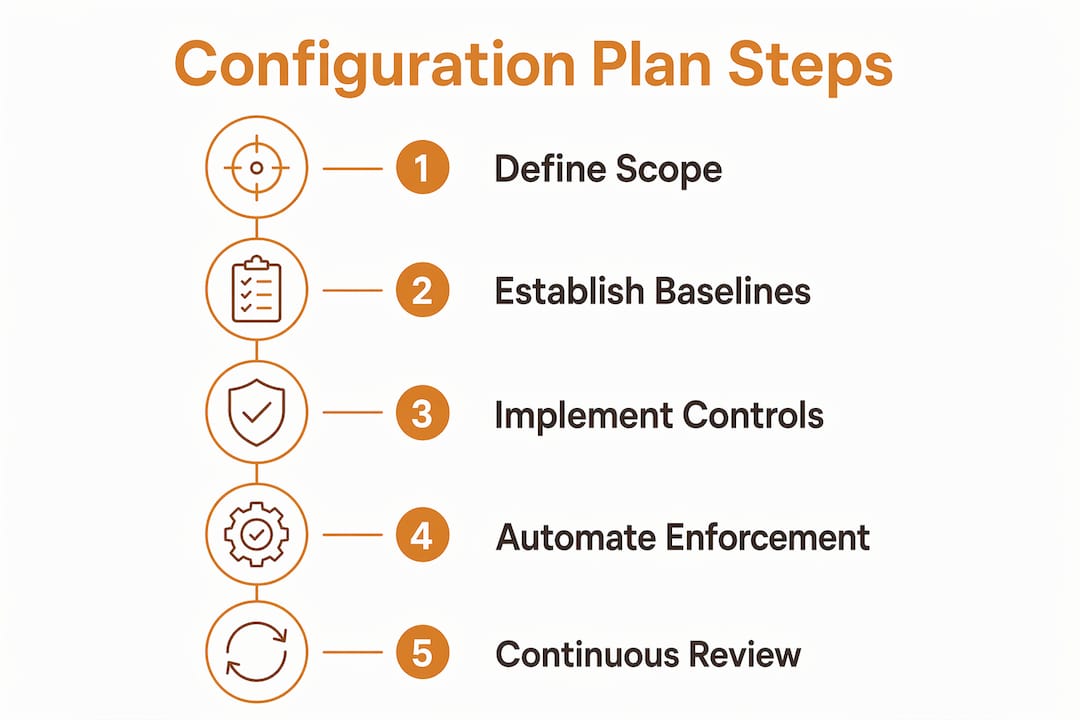
Automation is the mechanism that makes configuration standards enforceable at scale. NIST SP 800-53 CM-3(1) calls for automated tools to document changes, notify stakeholders, and block unauthorized modifications. Manual enforcement breaks down as infrastructure grows, and automation fills that gap reliably.
Practical automation enforcement works through three mechanisms:
- Change documentation. Tools like ServiceNow automatically generate change records when a configuration item is modified. The record captures who made the change, what changed, and when.
- Stakeholder notification. Azure Policy and AWS Config send alerts when a resource drifts from its defined state. Teams receive notification before a drift becomes an incident.
- Prohibition of unauthorized changes. Policy-as-code tools block deployments that violate defined standards. A server that does not match its approved baseline cannot be promoted to production.
Enforcing change notifications through automation minimizes manual errors and ensures consistent baseline policy enforcement across entire server fleets. The operational benefit extends beyond compliance. When an incident occurs, automated change logs provide a precise timeline of what changed before the failure. That timeline cuts mean time to resolution significantly.
Pro Tip: Configure AWS Config or Azure Policy rules to trigger automated remediation, not just alerts. For low-risk drift such as a missing tag or an open port, automated remediation closes the gap without requiring a human ticket.
How to create documented operating procedures for server management
Documented operating procedures are the written instructions that govern how administrators perform critical server tasks consistently. ISO 27001 control A.5.37 requires these procedures to be documented, accessible, current, and comprehensive across all critical operational activities. The control exists because undocumented processes produce inconsistent outcomes, especially when a new team member handles a task for the first time.
A complete set of server operating procedures covers:
- Server installation and provisioning. Step-by-step build instructions tied to the approved baseline configuration template.
- Backup and restore. Specific commands, schedules, retention policies, and restore verification steps. Vague backup procedures fail during actual recovery events.
- Error handling and escalation. Decision trees for common error conditions, with clear escalation paths and contact lists.
- Restart and recovery. Ordered shutdown and startup sequences for dependent services, including health checks after restart.
- Log management. Retention schedules, forwarding configurations to a SIEM such as Splunk or Microsoft Sentinel, and review responsibilities.
- Change control execution. The step-by-step process for implementing an approved change, including rollback procedures.
Documentation compliance fails unless procedures are accessible under incident pressure. A runbook stored in a shared drive that requires VPN access is useless when the VPN server is the thing that is down. Store procedures in a wiki platform such as Confluence or a dedicated runbook portal that operators can reach from any device, including a phone, during an outage.
Converting static documentation into executable operations reduces human error and elevates standard procedures to automated, reliable workflows. Tools like AWS Systems Manager Run Command and Rundeck execute runbook steps programmatically, with built-in verification checks after each action.
Why does a trustworthy CMDB matter for server standardization?
A Configuration Management Database (CMDB) is the authoritative record of all configuration items (CIs) in your environment, including servers, software, network components, and their relationships. ITIL 4 Service Configuration Management stresses that a CMDB is only valuable when its data is accurate, scoped correctly, and continuously reconciled. Stale or conflicting CMDB data leads to poor change decisions and slower incident resolution.
The table below compares a governed CMDB against an ungoverned one across key operational dimensions.
| Dimension | Governed CMDB | Ungoverned CMDB |
|---|---|---|
| CI scope | Defined, approved list of CI types | Ad hoc, inconsistent coverage |
| Lifecycle states | Active, retired, decommissioned tracked | States missing or inaccurate |
| Data quality | De-duplication and reconciliation rules enforced | Duplicate and stale records common |
| Relationship mapping | Service dependencies modeled | Relationships absent or manual |
| Change support | Impact analysis based on current data | Change decisions made without context |
Configuration data quality controls including scope definition, lifecycle state tracking, de-duplication, and reconciliation are what separate a useful CMDB from a liability. A reliable, governed CMDB provides the operational context that transforms change and incident processes from guesswork into evidence-driven decisions. When a server fails, a well-maintained CMDB tells you immediately which services depend on it, who owns it, and what changed recently.
Continuous discovery tools such as ServiceNow Discovery, Flexera, or CloudAware automate CI population and reconciliation. They reduce the manual effort of keeping the CMDB current, and they catch configuration drift that manual processes miss.
Key Takeaways
Standardizing server management processes requires formal baselines, a governed configuration plan, automated enforcement, accessible procedures, and a trustworthy CMDB working together as a system.
| Point | Details |
|---|---|
| Establish formal baselines | Document approved server states per NIST CM-2 and enforce them with tools like Puppet or Chef InSpec. |
| Build a configuration management plan | Assign owners, select tools such as Ansible or SCCM, and define formal change approval gates. |
| Automate change enforcement | Use Azure Policy, AWS Config, or ServiceNow to document, notify, and block unauthorized changes. |
| Store procedures accessibly | Keep runbooks in Confluence or a runbook portal reachable during outages, not behind VPN-only drives. |
| Govern your CMDB data | Apply scope rules, lifecycle states, and reconciliation to keep configuration records accurate and decision-ready. |
What I have learned from years of server standardization work
The hardest part of standardizing server management is not the technology. It is the organizational behavior around documentation and change governance. Teams adopt tools quickly. They resist the discipline of updating a baseline record or filing a change request for a "small" fix.
The most damaging pattern I have seen is the informal change. An administrator patches a security vulnerability at 2 a.m. without a change record because the fix is urgent and obvious. Three weeks later, a configuration audit flags the server as non-compliant, and no one can explain why the state differs from the baseline. That single undocumented change costs more time to investigate than the original patch took to apply.
Accessible documentation is the second area where teams consistently underinvest. I have watched experienced administrators freeze during an incident because the recovery runbook was in a system they could not reach. The procedure existed. It was even accurate. But it was inaccessible at the moment it was needed most. Storing runbooks in a platform that works independently of the infrastructure being recovered is not optional.
The teams that execute standardization well share one trait: they treat configuration data as a product with an owner, a quality standard, and a review cycle. They do not let the CMDB become a graveyard of stale records. They assign someone to govern it, and they measure data quality as a real operational metric.
Automation is the force multiplier, but it requires a clean baseline to enforce. Start with accurate documentation, then automate enforcement on top of it. Reversing that order produces automated enforcement of the wrong standard, which is worse than no enforcement at all.
— Sadler
Myserveriq: built for administrators who need reliable server control
Administrators who want to put these principles into practice without building every component from scratch have a direct path forward with Myserveriq.
Myserveriq is a specialized platform designed for server administrators who need clear visibility into configuration state, resource utilization, and performance trends. The platform applies proprietary algorithms to surface issues before they escalate, and users report a 30% improvement in resource utilization after adoption. Myserveriq integrates baseline tracking, change notifications, and performance dashboards into a single interface, reducing the tool sprawl that makes standardized IT operations difficult to maintain. Administrators can explore Myserveriq's full capabilities and see how the platform supports consistent, auditable server management from day one.
FAQ
What is a baseline configuration in server management?
A baseline configuration is a formally reviewed, documented snapshot of a server's approved hardware settings, software, and security controls. NIST SP 800-53 CM-2 defines it as the reference point used to detect deviations and enforce consistency across server builds.
Why does automation matter for standardized IT operations?
Automation documents changes, notifies stakeholders, and blocks unauthorized modifications without relying on manual processes. NIST CM-3(1) specifically requires these automated controls to enforce configuration standards consistently across server fleets.
What should documented server operating procedures cover?
Procedures must cover installation, backup and restore, error handling, restart sequences, log management, and change control execution. ISO 27001 A.5.37 requires these procedures to be accessible where operators work, including during active incidents.
What makes a CMDB trustworthy for server management decisions?
A trustworthy CMDB enforces CI scope, tracks lifecycle states, removes duplicates, and reconciles data continuously. ITIL 4 Service Configuration Management identifies these data quality controls as the foundation for reliable change and incident management.
How often should server baselines be reviewed and updated?
Baselines require review whenever a system change, new patch, or updated security requirement alters the approved state. A quarterly review cycle is the minimum standard for environments where configurations evolve regularly.