
Servers are required by federal tax law to maintain a contemporaneous daily record of every tip they receive, including cash, credit card, and pooled tips. This is not optional guidance. The IRS mandates tip record retention under Internal Revenue Code §6053, and failing to comply puts you at risk of penalties, audits, and inflated tax bills. Whether you work a busy Friday dinner shift or a slow Tuesday lunch, every dollar in tips counts toward your taxable income. Knowing exactly what to record, how to record it, and why it protects you financially is the foundation of working smart in the restaurant industry.
Do servers need to save their tip records daily?
Yes, and the IRS is specific about what "daily" means. The agency requires tipped employees to maintain a daily log that captures every tip received on that calendar day, not at the end of the week or month. This standard is called contemporaneous recordkeeping, and it is the industry term tax professionals use to describe records made at or near the time the income was earned. Reconstructed estimates made weeks later carry far less weight in an audit.
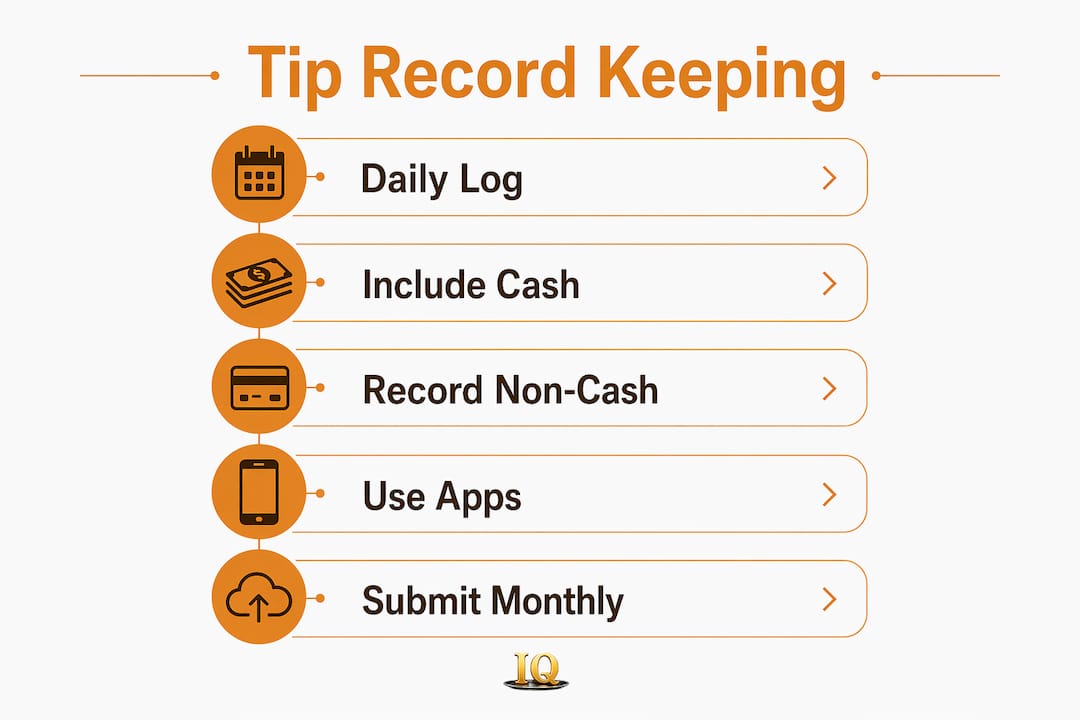
Your daily tip log must include:
- The date of the shift
- Cash tips received directly from customers
- Credit and debit card tips processed through the restaurant
- Tips received from other employees through tip pooling or tip-sharing arrangements
- Any tip-outs you paid to support staff, such as bussers or bartenders
Non-cash tips, such as tickets to events or other items of value given by customers, must also be recorded and reported to the IRS. This is one of the most commonly overlooked requirements in the industry. A concert ticket left as a tip has a fair market value, and that value is taxable income.
Pro Tip: Record your tips at the end of every shift before you leave the building. Your memory of a specific table's cash tip fades fast, and end-of-shift logging is the closest you can get to true contemporaneous accuracy.
How tip records affect your taxes and financial tracking
Every tip you earn is taxable income, full stop. The reporting threshold of $20 per month applies only to employer reporting, meaning you must report tips to your employer when they reach $20 in a calendar month. That threshold does not reduce what you owe the IRS on your annual tax return. All tips, including amounts under $20 in a given month, must appear on your Form 1040.
"The $20/month rule is one of the most misunderstood rules in restaurant work. Servers often think that if they don't hit that threshold, the tips are tax-free. They are not. Every dollar is taxable income on your annual return, regardless of whether you reported it to your employer."
This distinction matters because the IRS does not see your monthly employer reports as a complete picture of your income. Your annual return is the full accounting, and it must reflect all tips earned across every shift.
Tips also affect your Social Security and Medicare taxes. Both are calculated on your total earned income, which includes tips. Federal changes since 2025 allow servers to shield up to $25,000 of tip income from federal income tax under a new deduction, but that deduction does not eliminate Social Security or Medicare obligations. Recordkeeping remains mandatory regardless of any deduction you claim.
The table below shows how different tip scenarios affect your tax obligations:
| Tip scenario | Tax implication |
|---|---|
| Cash tips under $20/month | Still taxable on annual return; no employer report required |
| Credit card tips over $20/month | Taxable; must be reported to employer and on annual return |
| Pooled tips received from coworkers | Taxable income; must be logged and reported |
| Non-cash tips (event tickets, gifts) | Taxable at fair market value; must be recorded |
| Tips covered by the $25,000 deduction | Exempt from federal income tax; still subject to FICA taxes |
Employers use an 8% gross receipts formula to allocate tip income when employee-reported tips fall below that threshold. If your employer's allocation exceeds what you actually earned, you could end up paying taxes on income you never received. Accurate personal records are the only way to challenge that allocation with evidence.
Practical methods for recording tips after every shift
The IRS recommends IRS Form 4070A as a standard daily tip log. It is a simple paper form with fields for date, establishment name, cash tips, credit card tips, tips paid out, and net tips. You can download it free from the IRS website, print a stack, and keep it in your work bag. A personal notebook with the same fields works equally well as long as you fill it out every shift.
For servers who prefer a digital approach, the process is the same but faster. Here is a practical daily routine that works:
- End of shift, before you clock out. Count your cash tips and note the total. Pull up your credit card tip summary from the POS system if your restaurant provides it.
- Log each category separately. Record cash tips, card tips, and any tip-out amounts you received or paid. Keeping these separate makes tax preparation far easier.
- Note the date and shift. A log entry without a date is nearly useless in an audit. Always include the specific date, not just "Tuesday."
- Track tip-outs you paid. If you tip out a bartender or busser, record that amount. It reduces your net tips and your taxable income.
- Store records securely. The IRS recommends keeping tax-related records for at least three years. Digital records backed up to cloud storage are harder to lose than paper.
Point-of-sale systems at many restaurants automatically capture card tip totals. That data is useful, but it does not replace your personal log. POS records show what the system processed, not what you actually received in cash or what you paid out. Your personal record fills those gaps.
Pro Tip: Apps designed for tracking tips as a server let you log income by shift in under a minute. Voice-enabled tools make it even faster when your hands are full after a long night.

Avoid the common mistake of reconstructing your tip history from memory at tax time. Tax advisors consistently flag retroactive tip estimates as a major source of errors and audit triggers. A daily habit takes less than two minutes and protects you year-round.
Common misconceptions about tip reporting rules
Servers carry a lot of incorrect beliefs about tip reporting, and those beliefs cost real money. Here are the most damaging myths, corrected:
- "Tips under $20 a month are tax-free." False. The $20 threshold only determines whether you report to your employer. The IRS still expects all tip income on your annual return.
- "My employer's W-2 covers everything." Not necessarily. Your employer reports what you told them. If you underreported to your employer, your W-2 will be incomplete, and the IRS may flag the discrepancy.
- "Pooled tips are the restaurant's responsibility to track." Wrong. Each server is responsible for recording the tips they personally received, including amounts from tip pools. Your coworker's records do not substitute for yours.
- "The new tip tax deduction means I don't need to track tips anymore." Incorrect. The federal deduction introduced since 2025 reduces your income tax on qualifying tips, but you must still report and document all tips to claim it. No records means no deduction.
- "If I get audited, I can just estimate." The IRS views contemporaneous records as critical evidence during audits. Estimates made after the fact carry significantly less weight and can result in the IRS accepting the employer's higher allocation instead.
Underreporting tips, even unintentionally, leads to penalties. Voluntary disclosure of missed tips typically results in lower penalties than amounts discovered during an audit, but the best outcome is accurate reporting from the start.
Key Takeaways
Servers who keep a contemporaneous daily tip log are legally protected, financially accurate, and far less likely to face IRS penalties or inflated tax bills from employer allocations.
| Point | Details |
|---|---|
| Daily records are legally required | The IRS mandates contemporaneous tip logs under IRC §6053, covering cash, card, and pooled tips. |
| All tips are taxable | The $20/month employer threshold does not reduce what you owe on your annual tax return. |
| Employer allocations can cost you | Without personal records, you may pay taxes on tip income your employer estimated but you never earned. |
| Form 4070A is the standard tool | The IRS recommends this free daily log form; apps and notebooks work equally well when filled out each shift. |
| New deductions still require records | The federal tip income deduction since 2025 requires full documentation to claim. |
What I've learned from years of tracking every shift
I spent years working restaurant floors before I understood what was actually at stake with tip records. Early on, I did what most servers do: I kept a rough mental count, reported a round number to my employer, and hoped it was close enough. It was not a great system.
The moment it clicked for me was when a coworker got hit with a tax bill based on her employer's tip allocation, which was significantly higher than what she had actually earned. She had no personal records to dispute it. She paid taxes on income she never saw. That was the last time I treated tip logging as optional.
Daily logging takes less time than checking your phone between tables. The habit protects your income verification when you apply for a lease or a loan, because proving your income without a pay stub is a real challenge for servers, and a clean tip log is your best evidence. It also gives you a clear picture of which shifts and sections actually pay well, which is information most servers never have.
The servers I know who track consistently are also the ones who feel most in control of their finances. That is not a coincidence. Knowing your numbers removes the anxiety that comes with variable income.
— sadler
Serveriq makes daily tip tracking effortless
Keeping accurate tip records every shift is the right move, but it is also one more task at the end of a long night. Serveriq was built specifically for servers and bartenders who need a fast, reliable way to log tips, wages, and shift details without adding friction to their routine.
For $3 per month, Serveriq gives you a full earnings tracker with shift-by-shift reporting, so you always know where you stand. The virtual assistant Chip lets you log your tips by voice, which means you can record a full shift in seconds. Detailed reports make tax season straightforward, and your records are always organized and ready if the IRS ever asks. If you want tip tracking that actually fits your life as a server, Serveriq is the tool built for that job.
FAQ
Are servers legally required to keep tip records?
Yes. The IRS requires all tipped employees to maintain a contemporaneous daily record of tips received, including cash, card, and pooled tips, under Internal Revenue Code §6053.
What happens if I don't report my tips?
Failing to report tips leads to penalties and potential IRS audits. Voluntary disclosure of missed tips typically results in lower penalties than amounts discovered during an audit.
Do I need to track tips under $20 a month?
Yes. The $20/month threshold only determines whether you must report tips to your employer. All tips, regardless of amount, must be included on your annual federal tax return.
What is the best way to record tips daily?
The IRS recommends IRS Form 4070A for daily tip logging. Apps designed for tip tracking and personal notebooks with date, cash tips, card tips, and tip-outs recorded each shift are equally valid.
Does the new tip tax deduction eliminate the need to track tips?
No. The federal deduction available since 2025 shields up to $25,000 of tip income from federal income tax, but recordkeeping is still mandatory to claim it, and Social Security and Medicare taxes still apply.