
A server maintenance window is a scheduled time slot when a restaurant pauses normal service operations to perform planned upkeep, whether that means deep cleaning, equipment checks, restocking, or system updates that support daily service. For restaurant servers and bartenders, understanding this concept means fewer surprises during your shift and better control over your income and schedule. A well-managed maintenance window protects your earning potential by preventing the kind of chaotic, unplanned downtime that cuts tips and disrupts table flow. This guide covers what a maintenance window is, why it matters to your work, and how the best restaurants plan them to protect both staff and guests.
What is a server maintenance window and why does it matter?
A server maintenance window is a defined, pre-announced period when planned work takes place on the systems and equipment that keep a restaurant running. The term comes from IT operations, where it describes a scheduled period for planned updates designed to minimize business disruption. In a restaurant context, the same logic applies: you schedule the work, you tell the right people, and you do it at a time that causes the least harm to service and income.
The core purpose is control. Unplanned downtime, like a POS system crashing mid-dinner rush or a walk-in cooler failing on a Saturday night, costs servers real money in lost tables and tips. A planned window flips that equation. The work happens on your terms, at a time you choose, with staff and resources in place to handle it.
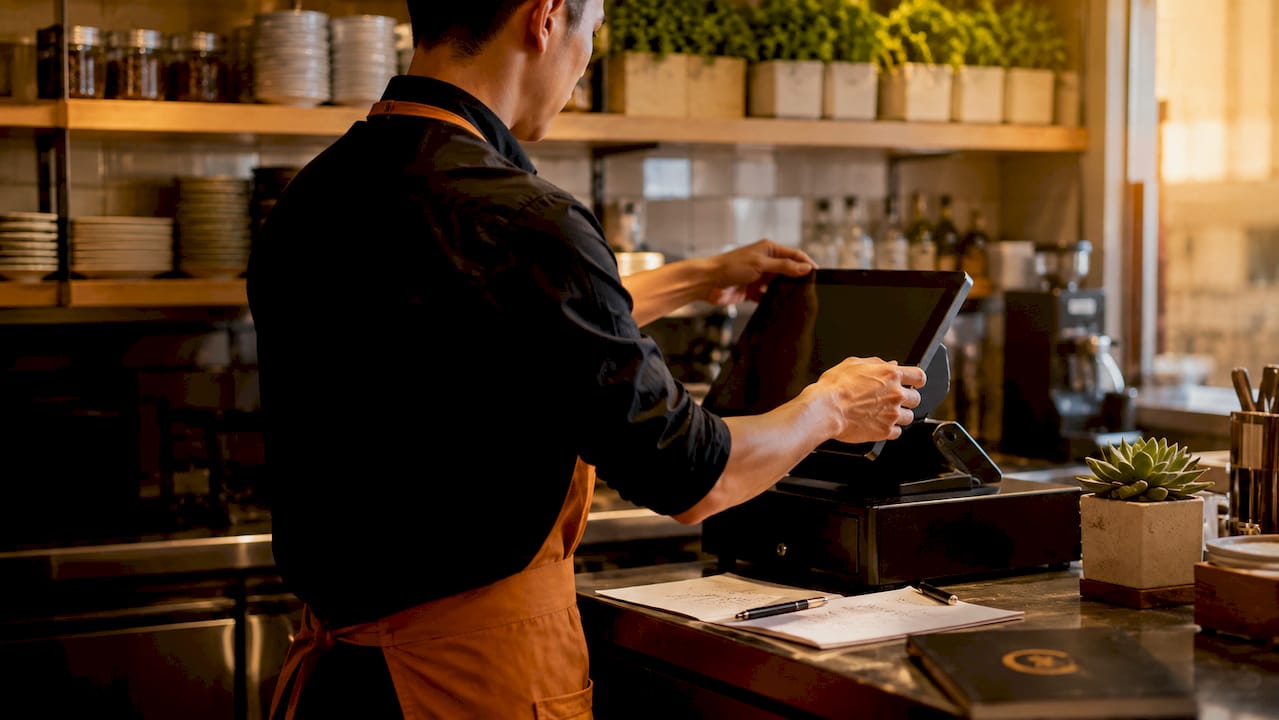
Maintenance windows have evolved from quiet technical chores into critical business events that influence customer trust and staff confidence. A restaurant that communicates planned downtime clearly signals professionalism to both guests and employees.
How do maintenance windows affect monitoring and alerts during service?
Monitoring in a restaurant context means tracking the systems that support your shift: POS terminals, reservation platforms, kitchen display screens, and payment processors. During a planned maintenance window, the best practice is to keep monitoring running but suppress non-critical alerts so staff are not flooded with false alarms about expected downtime.
This distinction matters more than most people realize. 53% of security alerts are false positives, and over a third of analysts ignore alerts during high-volume periods. That same fatigue hits restaurant managers who receive constant system notifications. When every alert looks the same, real problems get buried.
A well-configured maintenance window tags planned downtime as intentional, keeping uptime reports accurate and preventing the team from chasing phantom issues. Status pages, whether internal or guest-facing, should automatically reflect an "Under Maintenance" status so stakeholders receive clear notifications rather than an unexpected outage message.
Key behaviors during a properly managed maintenance window:
- Monitoring tools continue collecting raw data throughout the window
- Alerts for affected systems are muted, but unrelated systems stay fully monitored
- Status pages update automatically to show planned maintenance status
- Downtime is tagged as "planned" so it does not count against uptime SLA targets
- Staff and guests receive advance notice through the appropriate channels
Pro Tip: Never mute all alerts at once during a maintenance window. Mute only the specific systems undergoing work. An unrelated failure elsewhere in the restaurant will stay invisible until it becomes a crisis.
What are the common types of server maintenance windows?
Not all maintenance windows look the same. The type you use depends on the urgency, the scope of work, and the systems involved. Restaurant IT teams and operations managers typically work with three main categories.
| Window Type | Timing | Scope | Example |
|---|---|---|---|
| Routine maintenance | Weekly or monthly, off-peak hours | Patches, backups, minor updates | POS software update every Tuesday at 2:00 AM |
| Emergency maintenance | Unscheduled, immediate | Critical fixes only | Payment processor failure mid-service |
| Major upgrade window | Quarterly or annually, extended hours | Infrastructure changes, migrations | Full POS platform replacement |
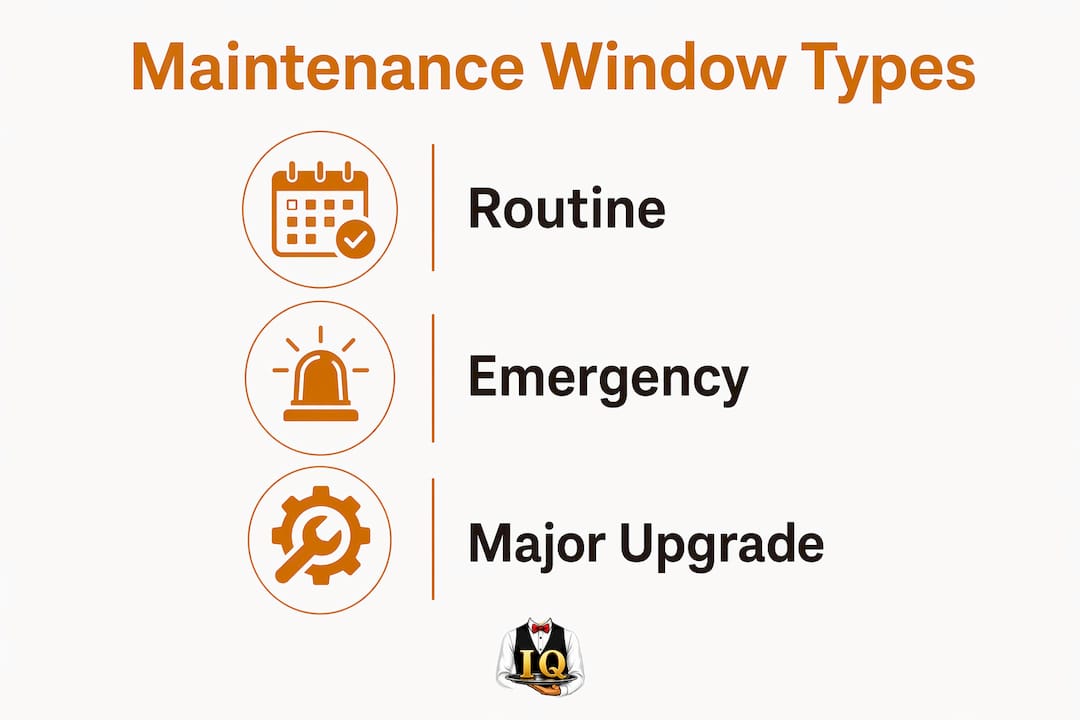
Routine windows are the backbone of a stable restaurant IT environment. They happen on a fixed schedule, usually during the slowest hours of the week, and cover predictable tasks like software patches, data backups, and hardware checks. Because they repeat on a known cycle, staff can plan around them without disruption.
Emergency maintenance windows are the exception, not the rule. They happen when something breaks and cannot wait. The goal is to fix the issue fast, communicate clearly, and document what happened. A restaurant that handles emergencies well has usually practiced with routine windows first.
Major upgrade windows require the most planning. Replacing a POS system, migrating to a new reservation platform, or upgrading kitchen display hardware all fall into this category. These windows run longer, involve more people, and carry higher risk. Scheduling them during a restaurant's annual slow period, such as a post-holiday week in january, reduces the business impact significantly.
How to schedule and manage maintenance windows effectively
Effective scheduling starts with one principle: choose the time that causes the least business harm, not just the time with the lowest traffic. Scheduling based on logs and usage patterns means reviewing call volume, payment activity, and reservation data before picking a window. A Tuesday at 3:00 AM might look quiet on a traffic chart but could conflict with overnight delivery schedules or early prep shifts.
Here is a practical process for scheduling a maintenance window in a restaurant environment:
- Review usage data. Pull POS transaction logs, reservation counts, and payment activity for the past four weeks. Identify the lowest-traffic two-hour block.
- Add a time buffer. Add a 20–30% buffer to your estimated maintenance duration. If the work should take 60 minutes, schedule 75–80 minutes. This prevents alert storms and incomplete deployments.
- Confirm staff availability. At least one technically capable staff member should be present or on call during the window. Do not schedule maintenance when your only IT contact is unavailable.
- Set maintenance exclusions. Modern scheduling tools support maintenance exclusions that block work from running during critical business periods like Friday dinner service or holiday weekends.
- Communicate the plan. Notify staff, managers, and relevant vendors at least 48 hours in advance. Update your status page so guests and stakeholders see the planned interruption rather than an unexplained outage.
- Document scope and rollback plan. Write down exactly what work will happen, what success looks like, and what steps to take if something goes wrong. This documentation becomes your audit trail.
Pro Tip: Extending a maintenance window before it expires is always better than letting it run over. An expired window triggers alert storms as monitoring systems interpret the continued downtime as an unexpected outage. Build the extension into your plan from the start.
Aligning your window with standardized server management processes reduces the chance of human error and makes each future window faster to execute.
What are the risks of maintenance windows and how do you reduce them?
Maintenance windows carry real risk, and the biggest mistake is treating them as routine when they are not. Veteran admins treat maintenance windows as controlled experiments rather than routine chores, because a server restart or system update can surface latent issues that were invisible during normal operation.
The most common risks in a restaurant maintenance window include:
- Unexpected failures on restart. A POS terminal that worked fine before the window may fail to come back online after a software update. Always test critical systems before declaring the window closed.
- Global alert muting. Muting all alerts globally during maintenance is a dangerous practice. An unrelated system failure, like a network switch going down, will go undetected until it causes visible service disruption.
- Incomplete deployments. Cutting a window short to meet a time target leaves systems in a half-updated state. This is worse than not starting the update at all.
- No rollback plan. Every maintenance window needs a documented path back to the previous state. If the update fails, you need to restore service fast, especially before a lunch or dinner rush.
- Post-maintenance blind spots. The 30 minutes after a window closes are the highest-risk period. Keep monitoring active and watch for anomalies before declaring the system healthy.
Mitigation comes down to preparation and discipline. Document the reason for every maintenance action. Keep detailed logs that support troubleshooting if something goes wrong. And never skip the post-window monitoring phase, even when the clock is running toward opening time.
Key Takeaways
A planned maintenance window is the single most effective tool for preventing unplanned restaurant downtime and protecting server income.
| Point | Details |
|---|---|
| Define the window clearly | A maintenance window is a scheduled, pre-announced period for planned work on restaurant systems. |
| Keep monitoring running | Mute only affected system alerts; keep all other monitoring active to catch unrelated failures. |
| Add a time buffer | Build a 20–30% buffer into every window estimate to prevent alert storms and incomplete work. |
| Schedule by business harm | Choose windows based on transaction data and staff availability, not just low-traffic times. |
| Document everything | Write down scope, rollback steps, and outcomes to build an audit trail for future windows. |
Maintenance windows are business decisions, not just technical ones
The framing I see most often gets this backwards. Teams treat a maintenance window as a technical task with a business inconvenience attached. The reality is the opposite. A maintenance window is a business decision that happens to involve technical execution.
Every time a restaurant schedules a window well, it protects server income, guest experience, and staff trust. Every time it goes poorly, because of poor timing, no communication, or a missing rollback plan, the cost lands on the people working the floor. Servers lose tables. Bartenders lose tips. Guests leave frustrated.
What I have found after watching this play out repeatedly is that the restaurants with the fewest service disruptions are not the ones with the best technology. They are the ones with the most disciplined planning habits. They pick their windows based on real data. They communicate early and clearly. They build in buffer time without being asked. And they treat every window, routine or emergency, as a chance to learn something about their systems.
The uncomfortable truth is that doing nothing is not a strategy. Waiting for something to break before scheduling maintenance is a choice, and it is the most expensive one you can make. The restaurants that manage rush hours without mistakes are the ones that have already handled the hard work before service starts.
Treat your next maintenance window as a controlled experiment. Define what you are testing, document what you find, and use that knowledge to make the next one faster and safer.
— sadler
How Serveriq supports smarter scheduling for restaurant staff
Restaurant servers work in environments where system downtime directly cuts into earnings. Serveriq is built for exactly that reality.
Serveriq gives servers and bartenders a clear picture of their income across every shift, including the ones disrupted by planned downtime or system outages. At $3 per month, the platform tracks tips, hourly wages, and variable pay so you always know where your earnings stand. The virtual assistant Chip lets you log shifts and update earnings by voice, which means no lost data even when the shift ends in chaos. When your restaurant schedules a maintenance window, your earnings tracking stays current regardless of what the POS system is doing. Serveriq keeps your financial picture accurate when the systems around you are not.
FAQ
What is a maintenance window in a restaurant context?
A maintenance window is a scheduled, pre-announced period when planned work occurs on restaurant IT systems or equipment. The goal is to perform necessary updates or repairs with minimal disruption to service and staff income.
How long should a restaurant maintenance window be?
The window should cover the estimated task duration plus a 20–30% time buffer to handle unexpected complications. Extending a window before it expires is always safer than letting it run over.
What is the best time to schedule a maintenance window?
The best time is the period with the lowest business harm, based on actual transaction logs and reservation data. Teams should also confirm that technical staff are available and that the window avoids known peak periods.
Should all alerts be muted during a maintenance window?
No. Only mute alerts for the specific systems undergoing planned work. Muting all alerts globally creates blind spots that can hide unrelated failures until they become serious service disruptions.
How do maintenance windows affect server uptime reports?
Properly tagged maintenance windows mark planned downtime as intentional, which keeps uptime statistics accurate and prevents false SLA violations. Status pages update automatically to show an "Under Maintenance" status rather than an unexpected outage.