
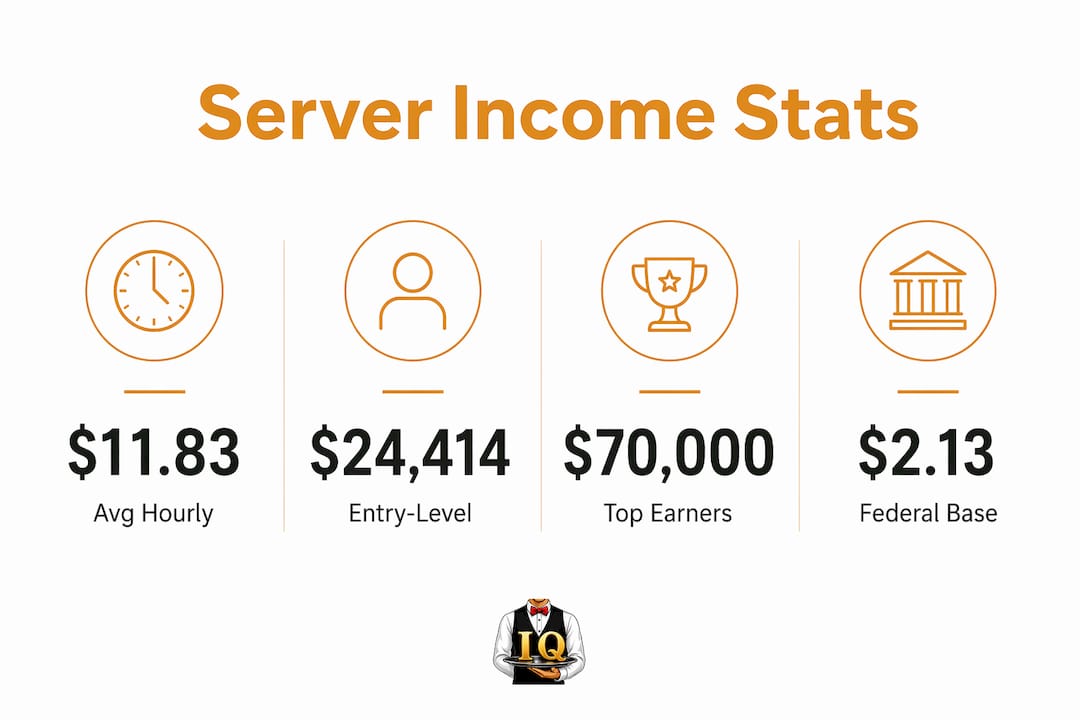
Average server income is defined as the total of an hourly base wage plus tips earned during each shift. The federal tipped minimum wage sits at $2.13 per hour, with employers allowed a tip credit of up to $5.12 per hour against the $7.25 federal minimum wage. That means most servers depend heavily on tips to reach a livable wage. Nationally, server hourly pay averages around $11.83, but total annual earnings can range from roughly $24,000 to over $76,000 depending on location, experience, and the type of restaurant you work in.
How do federal and state wage laws affect server pay?
The federal tipped minimum wage has stayed at $2.13 per hour for decades. That number shocks most people outside the industry. The tip credit system allows employers to count a portion of your tips toward meeting the $7.25 federal minimum wage, but the math only works if you actually earn enough in tips.
The legal rule is clear: if your tips plus your base wage fall below the federal minimum wage in any given workweek, your employer must make up the difference. This obligation exists on paper, but enforcement gaps are common. Many servers never realize they are owed a top-up because they do not track their hourly earnings against the legal floor.
State laws vary significantly and often favor workers more than federal rules do. California pays servers $16.90 per hour with no tip credit allowed. Washington sets its base at $17.13 per hour. Minnesota requires a tipped minimum of $11.41 per hour. In these states, tips are pure income on top of a stronger base wage, which changes the math entirely.
Key differences in state wage structures include:
- No tip credit states: California, Washington, Oregon, and Minnesota require employers to pay the full state minimum wage before tips.
- Low base wage states: States following the federal $2.13 floor include Georgia, Indiana, and Texas, where tips carry the most weight.
- Employer notification rules: Employers must inform you in writing before applying a tip credit to your wages. If they skip this step, the tip credit is invalid.
Pro Tip: Check your state's Department of Labor website to confirm your tipped minimum wage. If your employer has never explained the tip credit to you in writing, you may have grounds to recover unpaid wages.
What is the average server income range across the U.S.?
Server earnings vary more than almost any other hourly job in America. The national average annual salary for servers sits at approximately $46,916, with average tip pay adding around $29,876 on top of base wages. That combined figure reflects what servers in mid-range and upscale restaurants typically earn. Entry-level servers in casual dining often see far less.
Entry-level vs. experienced server earnings
Entry-level servers average around $24,414 per year. That figure reflects newer workers in lower-volume or casual dining settings where check averages and tip percentages are modest. Experienced servers in fine dining or high-traffic urban restaurants can push well past $60,000 annually when tips are strong.
The hourly pay range runs from as low as $3 per hour to more than $20 per hour depending on tip volume and base wage. That $3 figure represents a slow shift at a low-tip establishment. The $20-plus end reflects a skilled server on a busy Saturday night at a restaurant with high check averages.
A real-world example: Minneapolis, MN
Minneapolis shows what a strong local labor market looks like for servers. The average hourly wage for servers there is about $16.45, with average daily tips near $120. Minnesota's higher tipped minimum wage drives the base up, and the city's active dining scene keeps tip volume healthy. A server working five shifts per week in Minneapolis could realistically earn $2,400 or more per month before taxes.
| Experience Level | Estimated Annual Income | Notes |
|---|---|---|
| Entry-level | ~$24,414 | Casual dining, lower check averages |
| Mid-level | ~$46,916 | Full-service restaurants, consistent tips |
| Experienced | $60,000–$76,000+ | Fine dining, high-volume, peak shifts |
| Minneapolis average | ~$16.45/hr + $120/day tips | Strong local wages and tip culture |
Establishment type matters as much as experience. A server at a neighborhood diner and a server at a steakhouse may have identical years of experience but earn vastly different incomes. The check average, the clientele, and the shift timing all shape what ends up in your pocket.
What factors influence how much servers earn?
Server income is not random. Specific, controllable variables determine whether you earn $30,000 or $70,000 in the same city.

Shift timing is one of the biggest levers. Friday and Saturday dinner shifts consistently produce the highest tip volume. Lunch shifts at casual restaurants generate far less. Servers who prioritize weekend evenings and holiday periods build a meaningfully higher annual income than those who default to weekday lunches.
Specialized skills separate average earners from top earners. Wine expertise and fine dining knowledge allow servers to move into upscale environments where check averages are higher and guests tip at a higher percentage. A server who can guide a table through a wine pairing earns more than one who cannot. Skills are more predictive of income growth than job titles alone.
Tip pooling policies affect take-home pay in ways many servers overlook. Some restaurants pool all tips and distribute them by hours worked. Others let servers keep their own tips. Knowing the policy before you accept a position helps you estimate your realistic earnings.
Strategies that consistently increase server income:
- Work high-volume shifts at restaurants with strong check averages.
- Build wine, cocktail, or dietary knowledge to upsell confidently.
- Learn the menu deeply so you can make genuine recommendations that increase check size.
- Build rapport with regular guests, who tend to tip higher than first-time visitors.
- Track your tips by shift to identify which sections, days, and times pay best.
Pro Tip: Payment method affects tip size. Guests paying by credit card tend to tip at higher percentages than cash payers. If your restaurant allows you to suggest card payment, it can meaningfully increase your average tip per table.
Career progression also matters. Moving from server to lead server, then to floor manager or restaurant director, increases base pay significantly. The trade-off is that management roles often reduce or eliminate tip income. Many experienced servers deliberately stay on the floor because their total earnings exceed what management would pay.
How can servers track and prove their income?
Variable income creates real problems when you need to rent an apartment, apply for a loan, or file taxes accurately. Most servers cannot hand a landlord a pay stub that reflects their true earnings because tips often go unreported or are paid in cash.
The most reliable solution is consistent daily tracking. Modern tip tracking apps designed for servers log each shift's tips, base wages, and hours worked. Over time, this creates a documented income history that holds up for rental applications and tax filings.
Steps to build a solid income record:
- Log every shift immediately after it ends, including cash and card tips separately.
- Save your pay stubs, even if they only reflect your base wage.
- Use a tip tracking app to generate monthly and annual income reports.
- Keep a simple spreadsheet as a backup with date, hours, base pay, and tips.
- When applying for housing or credit, present your tax return alongside your income reports as a complete picture.
Proving income without pay stubs is possible when you have consistent records. Landlords and lenders accept bank statements, tax returns, and app-generated income summaries when they show a clear, consistent pattern.
Budgeting on variable income requires a different approach than budgeting on a fixed salary. Base your monthly budget on your lowest realistic income month, not your best month. Treat strong months as an opportunity to build a buffer. Servers who budget against their floor income rather than their ceiling avoid the cash flow problems that hit hardest in slow seasons like january and february.
Pro Tip: Calculate your take-home tips after tip-out to your busser, bartender, and host. Your gross tips and your net tips can differ by 20% or more depending on your restaurant's tip-out structure.
Key Takeaways
Server income is built on base wages and tips together, and understanding both components is the only way to accurately plan your budget or evaluate a job offer.
| Point | Details |
|---|---|
| Federal base wage | The federal tipped minimum is $2.13/hr; employers must cover any shortfall if tips don't reach $7.25/hr. |
| National income range | Annual server earnings run from ~$24,414 at entry level to over $76,000 for experienced servers in high-volume venues. |
| State laws change the math | States like California and Washington eliminate tip credits, giving servers a stronger guaranteed base wage. |
| Skills beat job titles | Wine knowledge, fine dining experience, and menu depth increase tips and open doors to higher-earning positions. |
| Track everything | Daily income records from a tip tracking app are the most reliable way to budget accurately and prove earnings. |
What I've learned about server income that most guides won't tell you
Most articles about server pay focus on averages and leave out the part that actually matters: the gap between what you earn and what you understand about your earnings. I've seen servers work busy restaurants for years without knowing their employer was applying a tip credit incorrectly. They were legally owed money and had no idea.
The tip credit system is genuinely confusing, and some employers count on that confusion. If you work in a state that allows tip credits, ask your manager in writing how the credit is calculated and applied. If they cannot explain it clearly, that is a red flag worth taking seriously.
The income ceiling for servers is higher than most people outside the industry realize. A skilled server in a fine dining restaurant in a major city can out-earn many office workers with college degrees. The path there is not random. It runs through deliberate skill-building, strategic shift selection, and consistent income tracking.
New servers often underestimate how much slow seasons affect their annual income. A strong october and november can mask a weak january and february. The servers who build financial stability are the ones who treat their income like a business, tracking every shift and saving aggressively during peak months.
My honest advice: treat your first year as data collection. Track every shift, every tip, every slow Tuesday. By month six, you will know exactly which shifts pay and which ones drain your time. That information is worth more than any general salary guide.
— sadler
Serveriq makes income tracking simple for servers
Knowing your average server income is one thing. Having a clear, daily record of it is another.
Serveriq is built specifically for servers and bartenders who need to track tips, hourly wages, and shift-by-shift earnings without the hassle of spreadsheets. For $3 per month, you get detailed income reports, a documented earnings history for rental and tax purposes, and Chip, a voice-activated assistant that lets you log a shift in seconds. Whether you are budgeting for a slow month or proving income to a landlord, Serveriq gives you the numbers you need. Start tracking your income and see exactly where your earnings stand.
FAQ
What is the average hourly wage for a server in the U.S.?
The national average server hourly wage is around $11.83, with a range from $3 to over $20 per hour depending on tips, experience, and location.
Do employers have to pay servers minimum wage if tips are low?
Yes. If a server's combined tips and base wage fall below the federal minimum wage of $7.25 per hour in any workweek, the employer is legally required to make up the difference.
How much do servers earn annually?
Entry-level servers average around $24,414 per year, while experienced servers in high-volume or fine dining settings can earn $60,000 to over $76,000 annually when tips are included.
What states pay servers the highest base wages?
California ($16.90/hr), Washington ($17.13/hr), and Minnesota ($11.41/hr tipped minimum) are among the states with the highest base wages for servers, with California and Washington eliminating tip credits entirely.
How can servers prove their income without a traditional pay stub?
Servers can document their earnings using tip tracking apps, bank statements, and annual tax returns. App-generated income reports showing consistent tip and wage history are widely accepted by landlords and lenders.