
Budgeting with variable income means building a financial system around your lowest consistent earnings, not your best week. For restaurant servers and bartenders, weekly pay swings are the norm. A slow Tuesday lunch shift and a packed Saturday night can produce wildly different paychecks. The good news is that knowing how to budget when your income changes every week does not require a finance degree. It requires a baseline, a buffer, and a weekly habit of checking where your money stands.
How to budget when your income changes every week
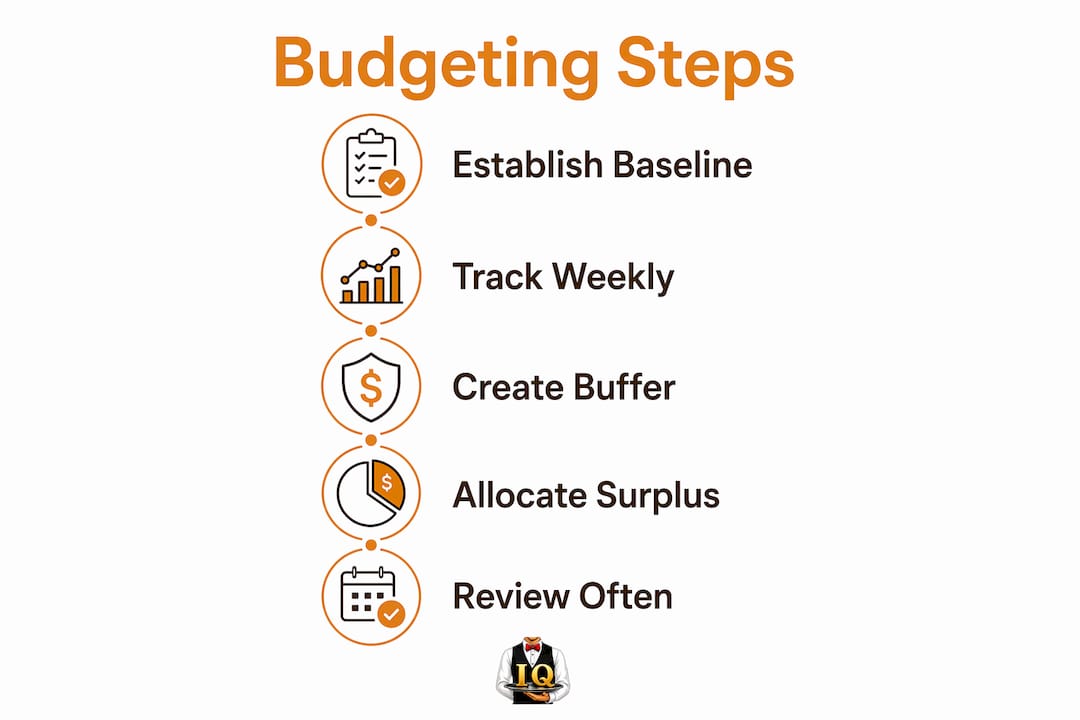
The foundation of flexible budgeting for servers starts with one number: your baseline income. This is the lowest amount you consistently earn across a typical week, not your average and not your best week. Experts recommend analyzing the last 3–6 months of income to find that floor. Your budget lives on that number.
Once you have your baseline, list every expense that must be paid no matter what. These fall into two groups:
- Fixed essentials: Rent or mortgage, car payment, insurance premiums, phone bill, minimum debt payments
- Variable essentials: Groceries, gas, utilities, and any recurring subscriptions you cannot cut
The goal is a survival budget. If you earn your baseline this week, can you cover every item on that list? If yes, your budget is built on solid ground. If no, something on the list needs to go or your income floor needs to rise.
Pro Tip: When converting weekly expenses to monthly costs, use 4.33 weeks as your average month length, not 4. Using 4.33 weeks prevents a small but real shortfall that adds up over a full year.
How do you build a buffer account for uneven paychecks?
A buffer account is a separate savings account that acts as your personal payroll department. You deposit income into it, then pay yourself a consistent weekly or biweekly "paycheck" regardless of what you actually earned that shift. This separates the chaos of tip income from the predictability your bills require.

Separating income into a buffer and a spending account creates a barrier that prevents accidental overspending of essential funds. Without this separation, a great Saturday night can feel like permission to spend freely on Sunday, leaving you short when rent is due.
Here is how to build and maintain your buffer:
- Open a dedicated account. Use a free checking or savings account at a different bank than your main account. Out of sight reduces temptation.
- Deposit all income here first. Every tip payout, every paycheck, every cash envelope goes into the buffer account before anything else.
- Pay yourself a fixed weekly amount. Calculate your baseline weekly income and transfer that amount to your spending account each week.
- Let the buffer grow during good weeks. When you earn above baseline, the extra stays in the buffer. That surplus becomes your cushion for slow weeks.
- Target 1–3 months of bare-bones expenses. A financial buffer of 1–3 months of essential expenses acts as a shock absorber and keeps you off credit cards during lean stretches.
Pro Tip: If you receive tips in cash or work as a 1099 contractor, open a third account labeled "Taxes." Setting aside 25–30% of every payment into a dedicated tax savings account prevents a painful surprise every april.
Why do weekly spending reviews beat monthly check-ins?
Monthly budget reviews are designed for people with predictable paychecks. For servers, a month is too long a window. By the time you notice a problem, you are already three weeks into overspending.
Weekly spending reviews of 15–20 minutes significantly reduce budget failure by catching overspending early and allowing timely adjustment. That is a small time investment for the financial clarity it delivers.
A practical weekly review looks like this:
- Check your buffer balance. Is it growing, holding steady, or shrinking? A shrinking buffer signals a problem before it becomes a crisis.
- Categorize last week's transactions. Group spending into essentials, discretionary, and savings. Most banking apps do this automatically.
- Check your pace against the month. If you are 40% through the month but have spent 60% of your discretionary budget, pull back now.
- Reallocate if needed. Move money between categories before the week starts, not after it ends.
Weekly reviews create multiple budget checkpoints, which reduces financial surprises compared to monthly reviews. Servers who review twice weekly, once around their busiest shift days and once on a quieter day, catch income timing issues before they cause overdrafts.
Tracking your tips and shifts accurately is the starting point for any review. Serveriq is built specifically for this. The app lets you log shifts, tips, and hourly wages by voice through its virtual assistant, Chip, so your income data is always current when you sit down for your weekly review. You can find a breakdown of the best apps for servers to help you choose the right tracking tool for your workflow.
What should you do with income above your baseline?
Surplus income is the money you earn above your baseline in a good week. The biggest mistake servers make is treating surplus as spending money. Lifestyle inflation during high-income periods is the fastest way to stay financially stuck.
Using a percentage system to allocate surplus income after meeting baseline expenses helps prioritize savings, taxes, and discretionary spending without guesswork. A simple allocation framework for surplus income looks like this:
| Surplus Category | Suggested Allocation | Purpose |
|---|---|---|
| Buffer top-up | 40% | Rebuild or grow your income cushion |
| Debt payoff | 30% | Accelerate high-interest debt reduction |
| Tax savings | 20% | Cover self-employment or tip income taxes |
| Discretionary | 10% | Guilt-free spending on wants |
These percentages are a starting point, not a rule. If you carry no high-interest debt, redirect that 30% to your emergency fund until you reach six months of survival expenses. That is the target for variable income earners who need a deeper safety net than salaried workers.
Automating savings contributions regardless of income variability creates financial resilience over time. Set a recurring transfer from your buffer account to a savings or investment account on the same day each week. Automation removes the decision from the equation, which means it actually happens.
One more detail that most budgeting guides skip: budgeting across 52 weeks rather than 48 means some months will have five paydays. Direct those extra paychecks entirely to savings or debt payoff. Do not absorb them into spending. That discipline is what separates servers who build wealth from those who stay paycheck to paycheck despite earning good money.
Key Takeaways
Budgeting with variable income works when you build your entire system around your lowest consistent earnings, not your average or best week.
| Point | Details |
|---|---|
| Establish a baseline income | Use 3–6 months of past earnings to find your lowest consistent weekly amount and budget from there. |
| Build a dedicated buffer account | Deposit all income into a buffer first, then pay yourself a fixed weekly amount to cover essentials. |
| Review spending every week | A 15–20 minute weekly review catches overspending early and prevents end-of-month budget failures. |
| Allocate surplus by percentage | Divide above-baseline income across buffer, debt, taxes, and discretionary spending using set percentages. |
| Automate savings contributions | Set recurring transfers so savings happen consistently, regardless of how much you earned that week. |
What I've learned from budgeting on tips
The hardest part of managing fluctuating income is not the math. It is the psychology. When you have a great Saturday night and walk out with $300 in tips, your brain tells you that you are doing fine. That feeling is the enemy of a good budget.
I learned this the hard way. For a long time, I tracked my income loosely and spent based on how flush I felt after a shift. The months where I worked fewer shifts or hit a slow season were brutal because I had no buffer and no system. The shift that changed everything was treating my buffer account like a bill. I stopped thinking of it as optional savings and started treating the weekly transfer as non-negotiable, the same way I treated rent.
The other thing nobody talks about is income timing. Even if you earn enough across a month, the timing of when tips hit versus when bills are due can create a cash crunch. Weekly reviews fix this. Checking your buffer balance and your upcoming bills twice a week gives you enough lead time to adjust before a problem becomes a crisis.
For servers specifically, the tools you use matter. Generic budgeting apps are built for salaried workers with predictable deposits. They do not account for cash tips, split shifts, or the difference between a holiday weekend and a slow January. Using a tool built for your income type, like Serveriq, means your data actually reflects how you earn. That accuracy makes every weekly review faster and more useful. If you are also working on proving your income for a lease or loan, knowing how servers can document earnings without a traditional pay stub is a skill worth having.
The mental benefit of having a system is real. When you know your buffer is funded and your bills are covered, a slow week stops feeling like a financial emergency. It is just a slow week.
— sadler
Serveriq makes income tracking simple for servers
Servers who track their tips and shifts accurately make better budget decisions. Serveriq is built for exactly that, at $3 per month.
The app lets you log every shift, tip, and hourly wage through Chip, its voice-activated virtual assistant. No manual entry, no forgotten shifts, no guessing at the end of the week. Serveriq generates detailed income reports that show your earnings patterns over time, which makes setting your baseline income and spotting slow seasons much easier. When your weekly review is backed by accurate data, your budget actually works. Visit the Serveriq subscription page to get started with income tracking built for the restaurant industry.
FAQ
How do I find my baseline income as a server?
Review your last 3–6 months of earnings and identify the lowest amount you consistently brought in each week. Build your budget around that number, not your average.
How much should I keep in my buffer account?
Target 1–3 months of bare-bones essential expenses. Once you reach that amount, direct surplus income toward an emergency fund with a goal of six months of survival expenses.
How often should I review my budget with variable income?
Weekly reviews of 15–20 minutes are the standard recommendation for variable income earners. Reviewing twice a week around your busiest shift days gives you the best early warning on cash flow issues.
What percentage of tips should I save for taxes?
Set aside 25–30% of every tip payment or self-employment income into a dedicated tax savings account. This prevents a large tax bill from disrupting your budget at year end.
What do I do with extra income in a five-paycheck month?
Direct the extra paycheck entirely to savings or debt payoff. Budgeting across 52 weeks rather than 48 means these months occur regularly, and treating them as windfalls rather than spending money builds long-term financial stability.