
Reporting cash tips to the IRS as a server means declaring every dollar of tip income you receive, whether or not your employer ever sees it. The IRS classifies all tips as taxable wages under the Internal Revenue Code, and that includes cash left on the table, tips split from a tip pool, and even non-cash tips like gift cards. Two separate obligations apply: one to your employer each month, and one to the IRS each year on your federal tax return. Getting both right protects your Social Security record, keeps you out of an audit, and in 2026, may qualify you for a brand-new tax deduction worth up to $25,000.
How to report cash tips to the IRS as a server: the employer step first
The first reporting obligation runs to your employer, not directly to the IRS. You must report tips exceeding $20 per employer per month, and the deadline is the 10th day of the following month. Miss a January deadline and you owe that report by february 10. That timing matters because your employer uses your reported tips to calculate payroll tax withholding.
The IRS does not require a specific form for this step. A written or electronic statement works as long as it includes:
- Your name, address, and Social Security number
- Your employer's name and address
- The month or period covered
- The total tips received during that period
IRS Form 4070 is the standard template most servers use, and it covers every required field. You can also use a simple written note or an employer-provided digital form, as long as it contains all the elements above.
Pro Tip: Keep a copy of every tip report you submit to your employer. If a payroll dispute arises, your copy is the only proof you have that you filed on time.
One critical misconception trips up many servers: the $20 threshold is a reporting trigger, not a tax exemption. If you earn $18 in cash tips one month, you do not report that amount to your employer. But you still owe income tax on it. Every dollar counts at tax time.
Why daily tip records are your best protection
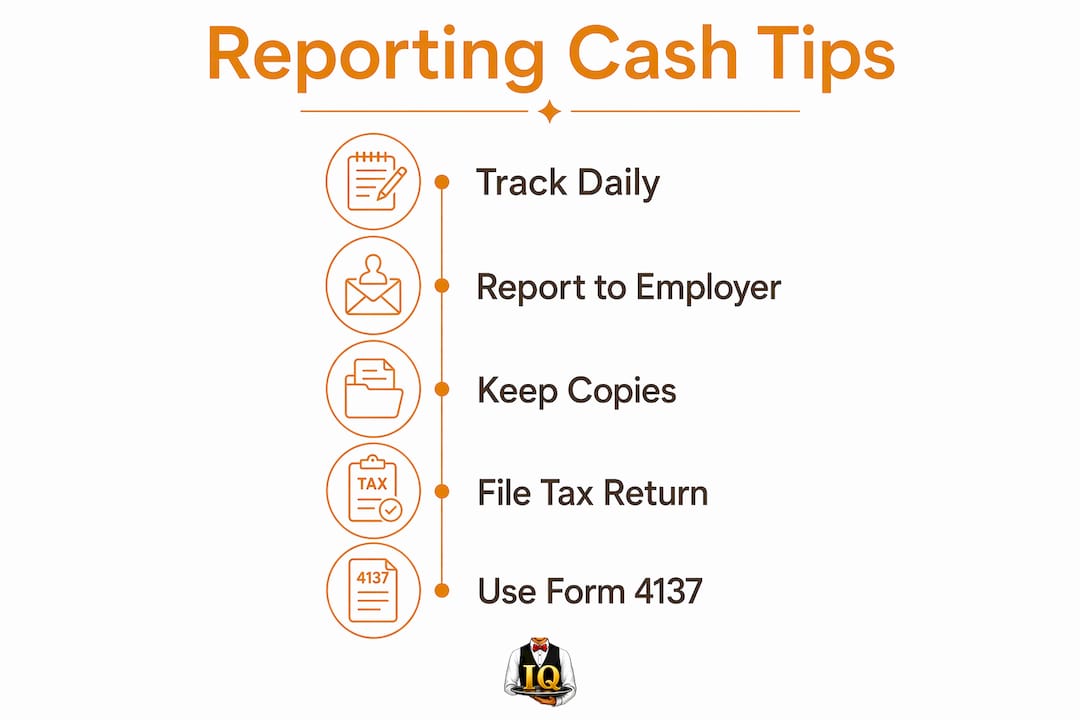
Daily records are the foundation of accurate cash tip income tax reporting. The IRS expects you to keep contemporaneous logs, meaning records created on the day you earn the tips, not reconstructed weeks later from memory.

IRS Form 4070A is the official daily record-keeping worksheet. It prompts you to log the date, establishment name, tips received directly from customers, tips paid out to other employees, and the value of any non-cash tips. You are not required to submit Form 4070A to anyone. It exists purely as your personal documentation.
Acceptable alternatives include:
- A dedicated notebook kept at home or in your bag
- A spreadsheet updated after each shift
- A tip tracking app that timestamps each entry
- POS system reports, if your restaurant's system captures tip data per server
The risk of skipping daily logs is real. Lump-sum estimates carry high audit risk because the IRS treats reconstructed totals as unreliable. If your reported tips fall below 8% of your restaurant's gross receipts, the IRS and your employer may allocate additional tip income to you, which triggers closer scrutiny. Contemporaneous daily records are the primary defense against that outcome.
Pro Tip: Log your tips before you leave the parking lot. A 60-second entry right after your shift is far more accurate than anything you reconstruct on a Sunday night before your report is due.
Serveriq was built specifically for this habit. Its virtual assistant, Chip, lets you log shifts and tip totals by voice command, so the record exists before you even start your car. At $3 per month, it costs less than a single forgotten dollar bill in your pocket.
How do you report unreported tips on your federal tax return?
All tips are taxable regardless of whether you reported them to your employer. That rule is absolute. If you failed to report tips to your employer during the year, you still must report unreported tips using Form 4137 when you file your federal return.
Form 4137 calculates the Social Security and Medicare taxes owed on tips you did not report to your employer. Here is how the process works:
- Add up all tips you received during the year, both reported and unreported.
- Subtract the tips you already reported to your employer.
- Enter the difference on Form 4137 as unreported tips.
- The form calculates the employee share of Social Security (6.2%) and Medicare (1.45%) taxes on that amount.
- Transfer the total from Form 4137 to Schedule 2 of Form 1040.
- Report your total tip income, including both reported and unreported amounts, on line 1 of Form 1040.
The consequences of underreporting are serious. The IRS treats tip income as a high-audit-risk area because of its cash nature. Underreported tips can result in back taxes, penalties, and interest. Beyond the immediate financial hit, underreporting reduces the earnings record used to calculate your future Social Security benefits. Every dollar you fail to report is a dollar that does not count toward your retirement.
| Scenario | Form used | Where it appears on 1040 |
|---|---|---|
| Tips reported to employer | None extra needed | Line 1, wages |
| Tips not reported to employer | Form 4137 | Schedule 2 + Line 1 |
| All tips, any amount | Form 1040 | Line 1 always |
What is the new 2026 qualified tip deduction for servers?
Starting in 2026, qualifying tipped workers can deduct up to $25,000 of tip income from federal taxes. This is the most significant change to server tax law in decades. The deduction phases out above certain Modified Adjusted Gross Income thresholds, so higher earners receive a reduced benefit.
To claim the deduction, your employer must report your cash tips correctly on your W-2 using two new codes:
- Box 12, Code TP: Reports cash tips received by the employee
- Box 14b: Reports the Treasury Tipped Occupation Code that confirms your job qualifies
Incorrect payroll reporting by your employer can disqualify you from claiming the deduction entirely. That means a payroll error you had nothing to do with could cost you thousands of dollars in tax savings.
"Employers and servers must collaborate to ensure new 2026 payroll codes are correctly implemented to access tip income deductions. A server who reports accurately but whose employer fails to use the correct W-2 codes may lose eligibility for the qualified tip deduction."
Ask your manager or payroll department now whether their system has been updated for the 2026 W-2 requirements. Do not wait until tax season. If your W-2 arrives in january without Code TP in Box 12, contact your employer immediately to request a corrected Form W-2C before you file.
The deduction only applies to tips received in occupations the Treasury Department designates as tipped. Restaurant servers and bartenders are included. Confirm your specific role qualifies before counting on the deduction.
Key Takeaways
Accurate daily tip records are the single most important habit a server can build for IRS compliance and long-term financial protection.
| Point | Details |
|---|---|
| Employer reporting threshold | Report tips over $20 per month to your employer by the 10th of the following month. |
| $20 is not a tax exemption | All tips are taxable on Form 1040 regardless of the monthly reporting threshold. |
| Form 4137 for unreported tips | Use Form 4137 to calculate Social Security and Medicare taxes on tips not reported to your employer. |
| Daily logs beat monthly estimates | Contemporaneous records are your primary defense in an IRS audit. |
| 2026 deduction requires correct W-2 | Confirm your employer uses Code TP in Box 12 and the correct Box 14b code to claim up to $25,000 in deductions. |
The habit most servers skip, and why it costs them
I have talked with a lot of servers about taxes, and the pattern is consistent. Most people report their tips in a rough monthly lump sum, usually the night before the deadline, based on a mental estimate. That approach feels fine until it is not.
The IRS does not audit every server. But when it does, the first thing an examiner asks for is your daily records. A notebook, a spreadsheet, an app with timestamped entries. If you cannot produce one, your employer's records become the only reference point, and those records may not match what you actually earned. The gap between what you reported and what the IRS calculates can result in back taxes plus a 20% accuracy-related penalty.
The Social Security angle is the one that surprises people most. Every dollar of tip income you underreport is a dollar that does not count toward your Social Security earnings record. For a server who works 20 years in the industry, consistent underreporting can meaningfully reduce monthly retirement benefits. That is a real cost, paid decades later, that most people never connect back to the tip they pocketed on a Tuesday night.
The 2026 qualified tip deduction raises the stakes further. Accurate reporting is no longer just about avoiding penalties. It is now the prerequisite for claiming a deduction that could put real money back in your pocket. Servers who have been sloppy about records will not be able to reconstruct a clean history overnight. The time to build the habit is now, before the deduction becomes part of your annual filing.
— sadler
Serveriq makes daily tip tracking effortless
Tracking cash tips every day sounds simple until a double shift ends at midnight and the last thing you want to do is open a spreadsheet. Serveriq solves that problem with a voice-activated assistant named Chip, who logs your shift and tip totals in seconds.
For $3 per month, Serveriq generates detailed earnings reports that break down your tips by shift, week, and month. Those reports map directly onto your employer's monthly reporting requirement and give you clean, timestamped records for your annual tax filing. When the 2026 tip deduction is on the line, having IRS-ready tip records in one place is worth far more than the subscription costs. You can also explore the best tip tracking apps to find the right fit for your workflow.
FAQ
Do I have to report cash tips under $20 to the IRS?
Yes. The $20 threshold only determines whether you must report tips to your employer that month. All tip income, regardless of amount, is taxable and must appear on your Form 1040.
What happens if I forget to report tips to my employer?
You must report those tips on Form 4137 when you file your federal tax return. Form 4137 calculates the Social Security and Medicare taxes owed on any tips not reported to your employer during the year.
How does the 2026 tip deduction affect how I report cash tips?
Qualifying servers can deduct up to $25,000 in tip income starting in 2026, but only if your employer correctly reports your cash tips using Code TP in Box 12 of your W-2. Confirm your employer has updated their payroll system before you file.
What records does the IRS accept as proof of tip income?
The IRS accepts daily logs created at the time you earned the tips, including IRS Form 4070A, notebooks, spreadsheets, or timestamped app entries. Monthly estimates reconstructed from memory carry significant audit risk.
Can underreporting tips affect my Social Security benefits?
Yes. Tips reported to your employer count toward your Social Security earnings record. Underreported tip income reduces that record, which can lower your monthly Social Security benefit when you retire.