
Accurate holiday and banquet pay tracking is defined by one critical distinction: mandatory service charges are wages, not tips. The IRS treats these two payment types completely differently, and misclassifying service charges as tips can trigger tax penalties and incorrect payroll withholdings. For event servers working weddings, corporate dinners, and holiday galas, understanding how to track holiday and banquet pay correctly is the difference between a clean W-2 and a costly audit. This article covers the tools, steps, and best practices that make banquet staff payment methods accurate, compliant, and fair in 2026.
How event servers can track holiday and banquet pay accurately
The foundation of accurate event server payroll tracking starts with separating two income streams that look similar but are legally distinct. Voluntary tips are amounts guests choose to leave. Mandatory service charges are fees the venue or employer sets and collects, then distributes to staff. The IRS reports mandatory service charges as wages on W-2 forms, subject to standard withholding. Voluntary tips carry separate reporting requirements under IRS Publication 531.
This distinction matters most during holiday event pay management, when banquet contracts often bundle both types of payment. A server working a New Year's Eve gala might receive a 20% mandatory service charge from the contract plus additional cash tips from guests. Treating both as the same income type creates a tax error from the start. Defining each category correctly in your payroll system before the event is the only way to avoid that mistake.
What tools do event servers need for pay tracking?
Effective tracking income for event servers requires three integrated systems working together: a point-of-sale (POS) system, a scheduling and time-tracking tool, and a payroll platform.
| Tool category | Core function | Key feature for banquet pay |
|---|---|---|
| POS system | Captures tip and service charge data at payment | Separates voluntary tips from mandatory fees |
| Time and attendance app | Records clock-in and clock-out with location | GPS-verified logs for off-site events |
| Payroll platform | Processes wages, withholdings, and exports | Payroll-ready exports to ADP, Gusto, or QuickBooks |
GPS-verified check-in apps create indisputable attendance logs, eliminating disputes over shift hours and pay. Manual sign-in sheets and verbal confirmations do not hold up during audits. For off-site holiday events held at ballrooms or private estates, location-aware clock-ins provide the timing precision that payroll calculations require.
The payroll platform ties everything together. Automating payroll-ready exports eliminates manual data entry errors, which are a leading cause of missed payments and rounding mistakes in banquet pay. Platforms that connect directly to ADP, Gusto, or QuickBooks remove the re-entry step entirely.
Pro Tip: Set up tip and service charge categories in your POS system before the first event of the holiday season. Changing category labels mid-season creates reconciliation headaches that take hours to untangle.
Step-by-step process for documenting banquet and holiday pay
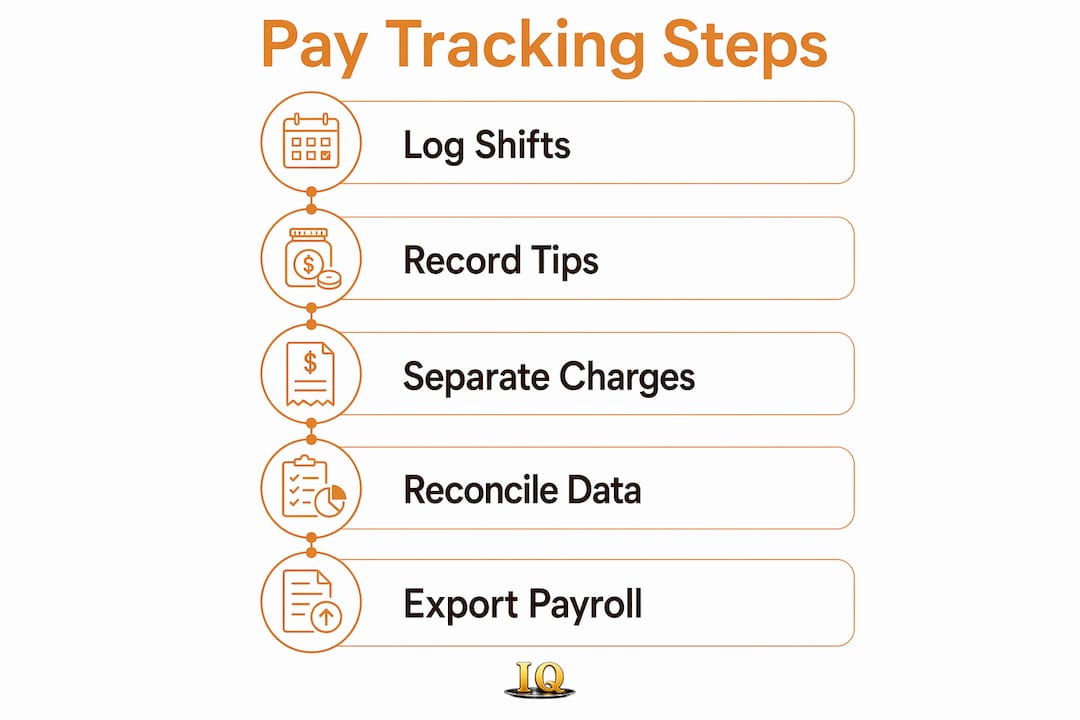
A clear process prevents the errors that accumulate across a busy holiday season. Follow these steps from shift start to payroll export.
-
Clock in with GPS verification. Use a location-aware app at the start of every shift, including off-site events. This creates a timestamped, location-confirmed record that payroll cannot dispute.
-
Capture tip and service charge data at the POS. Every payment processed through the POS should automatically tag income as either a voluntary tip or a mandatory service charge. Never combine them in a single line item.
-
Record holiday pay premiums separately. If your employer pays a holiday rate (for example, time and a half on Thanksgiving), that premium must appear as a distinct line in the payroll record. Folding it into base wages obscures the calculation.
-
Apply the correct tip pooling method. Weighted or hours-based tip pooling models are the industry standard for banquet environments. Hours-based scaling works best for complex schedules. Weighted point models suit mixed-role teams where a captain, server, and busser each earn a different share.
-
Get manager approval before payroll export. A manager review step catches discrepancies between POS totals and payroll data before they become underpayments. Build this approval into the workflow, not as an afterthought.
-
Export to payroll and retain records. Run the payroll export and save the tip distribution report, the POS summary, and the time records together. Weekly and monthly reconciliation of POS tips with payroll reports prevents mismatches and makes W-2 preparation straightforward at year-end.
Pro Tip: Ask your manager for a written copy of the tip pool formula before each event season. Documentation of tip pool formulas is the only reliable defense against payroll errors and IRS audits.
What are the most common mistakes in holiday and banquet pay tracking?
The most frequent error is mixing mandatory service charges with voluntary tips in the same payroll category. This single mistake creates cascading problems: incorrect withholding, wrong W-2 amounts, and potential IRS liability. Servers who misclassify mandatory banquet fees as tips risk take-home pay penalties that show up months later at tax time.
Other common problems include:
- POS and payroll mismatches. The POS shows one tip total; the payroll system shows another. This usually happens when someone manually re-enters POS data instead of using an automated export.
- Cash tip under-declaration. Servers working banquet events often receive cash tips from guests in addition to the service charge. Cash tips are taxable income and must be reported, even when no receipt exists.
- Missed punches. A forgotten clock-out at the end of a long holiday shift can shorten the recorded hours, cutting the paycheck. GPS-verified apps flag missed punches automatically.
- Late charges. Some banquet contracts allow guests to add gratuity after the event closes. These late charges need a defined workflow so they reach the correct pay period.
Waiting until december to reconcile a full year of banquet pay is the single most avoidable mistake event servers make. Monthly reconciliation turns a two-day year-end scramble into a 30-minute review.
Pro Tip: Set a recurring calendar reminder on the first Monday of each month to compare your POS tip summary against your pay stub. Catching a $40 discrepancy in november is far easier than untangling six months of errors in january.
How does transparency improve banquet and holiday pay management?
Transparent digital tip tracking increases staff morale and trust in pay distribution. Servers working irregular banquet schedules prefer digital access to detailed earning breakdowns over receiving a cash envelope with no explanation. When the math is visible, disputes drop and confidence in the employer rises.
Practical transparency strategies that work in banquet teams include:
- Shared digital dashboards. Give servers read access to their own tip distribution records after each event. They should see the total pool, the formula applied, and their individual share.
- Written tip pool policies. Post the pooling formula in writing before the season starts. Consistent application across all events and locations removes the perception of favoritism.
- Real-time data validation. Systems that flag discrepancies between POS data and payroll totals before the pay period closes give servers confidence that errors get caught and corrected, not buried.
- Regular policy communication. A five-minute pre-shift briefing before a major holiday event, covering how tips and service charges will be handled, prevents more disputes than any after-the-fact correction.
Digital access to earnings detail fosters better morale among infrequently scheduled banquet servers. A server who works three events per month and can review their full breakdown online is far less likely to question their pay than one who relies on a paper envelope.
Key Takeaways
Accurate holiday and banquet pay tracking requires separating mandatory service charges from voluntary tips, applying automated pooling methods, and reconciling POS data with payroll records every month.
| Point | Details |
|---|---|
| Separate income types | Classify mandatory service charges as wages and voluntary tips separately from the first event. |
| Use GPS-verified time tracking | Location-aware clock-ins create audit-proof attendance records for off-site holiday events. |
| Apply the right pooling model | Use hours-based or weighted tip pools to distribute banquet pay fairly across mixed-role teams. |
| Reconcile monthly, not annually | Monthly POS-to-payroll reconciliation prevents year-end errors and simplifies W-2 preparation. |
| Document everything in writing | Written tip pool formulas and signed acknowledgments are the primary defense in any IRS audit. |
What I've learned tracking banquet pay through a dozen holiday seasons
The servers who get burned at tax time are almost never the ones who cheated. They are the ones who trusted a verbal explanation of how the service charge worked and never asked for it in writing. I have watched talented, hardworking banquet servers owe money in april because their employer categorized a mandatory 22% service charge as a tip for months, and nobody caught it until the W-2 arrived.
The technology available in 2026 removes most of the guesswork. Integrated tip tracking apps built for servers handle the IRS distinction automatically. They export clean payroll data and flag mismatches before they become problems. The servers who use them spend less time disputing pay and more time working events.
My honest advice: do not wait for your employer to hand you a system. Learn how to track tips for taxes yourself, log every shift the day it happens, and reconcile your records monthly. The holiday season is the highest-earning stretch of the year for most event servers. Protecting those earnings takes about ten minutes a week when you have the right tools in place.
— sadler
Serveriq makes holiday and banquet pay tracking simple
Event servers working the holiday season need a pay tracking tool built for variable income, tip pools, and IRS compliance. Serveriq is designed exactly for that.
For $3 per month, Serveriq lets you log shifts, track tips and service charges separately, and review detailed earnings reports. The virtual assistant Chip accepts voice commands, so you can update your income the moment a shift ends without typing a single number. Payroll-ready exports mean your records are clean when tax season arrives. Visit the Serveriq subscription page to get started and keep every dollar you earn this holiday season accounted for.
FAQ
What is the difference between a service charge and a tip?
A mandatory service charge is a set fee collected by the employer and reported as wages on a W-2. A voluntary tip is a guest's discretionary payment with separate IRS reporting requirements.
How do event servers track tips for tax purposes?
Event servers should log every tip and service charge received per shift, reconcile those records against POS reports monthly, and report all cash tips as taxable income on their federal return.
What tip pooling method works best for banquet teams?
Hours-based tip pooling works best for complex banquet schedules, while weighted point models suit mixed-role teams where captains, servers, and bussers hold different responsibilities.
How often should banquet pay records be reconciled?
Monthly reconciliation of POS tip data against payroll records is the standard practice. It prevents mismatches from compounding and makes year-end W-2 preparation straightforward.
Can GPS apps really help with holiday event pay tracking?
Yes. GPS-verified clock-in apps create timestamped, location-confirmed attendance records that eliminate disputes over hours worked, especially for off-site holiday events.