
Professional Services Automation (PSA) tools are the operational backbone for managed service providers running restaurant server teams. They centralize shift scheduling, tip tracking, billing, client communication, and payroll into one platform, replacing the patchwork of spreadsheets and disconnected apps that slow most restaurant operations down. For MSPs supporting hospitality clients across the United States, PSA software does what no single monitoring tool can: it connects the business side of service delivery to the people doing the work.
The role of PSA tools in server management goes well beyond invoicing. A well-configured PSA gives you real-time visibility into labor costs per client account, flags scheduling gaps before a Friday dinner rush, and automates the billing cycle so nothing slips through. It complements technical monitoring tools like Remote Monitoring and Management (RMM) software, which handle the infrastructure side. PSA handles the business side. Together, they create a complete picture.
Key advantages at a glance:
- Centralized shift and schedule management for restaurant server teams
- Automated tip reconciliation and wage tracking per server
- Integrated billing and invoicing tied to actual hours worked
- Client account management across multiple restaurant locations
- Reporting dashboards that surface earnings patterns and labor efficiency
What are the core components of PSA software for restaurant server management?
PSA software is built around five interconnected functions, each addressing a specific pain point in restaurant service operations.
Project and shift management gives managers a structured way to coordinate service tasks, assign tables or sections, and track completion. Unlike a generic calendar tool, PSA platforms built for service delivery include task dependencies, priority flags, and real-time status updates.
Resource management focuses on staff availability and skill matching. A PSA system can identify which servers are certified for alcohol service, who has open availability on a Saturday night, and where coverage gaps exist before they become a problem.

Financial oversight covers billing, tip reconciliation, and invoicing. PSA software automates invoicing and tracks billable hours with accuracy, eliminating the manual data entry that causes payroll errors in high-volume restaurant environments.
Service desk ticketing handles client requests and incident tracking. When a restaurant manager submits a complaint or a special event request, the PSA logs it, assigns it, and tracks resolution without anyone losing the thread in a group chat.
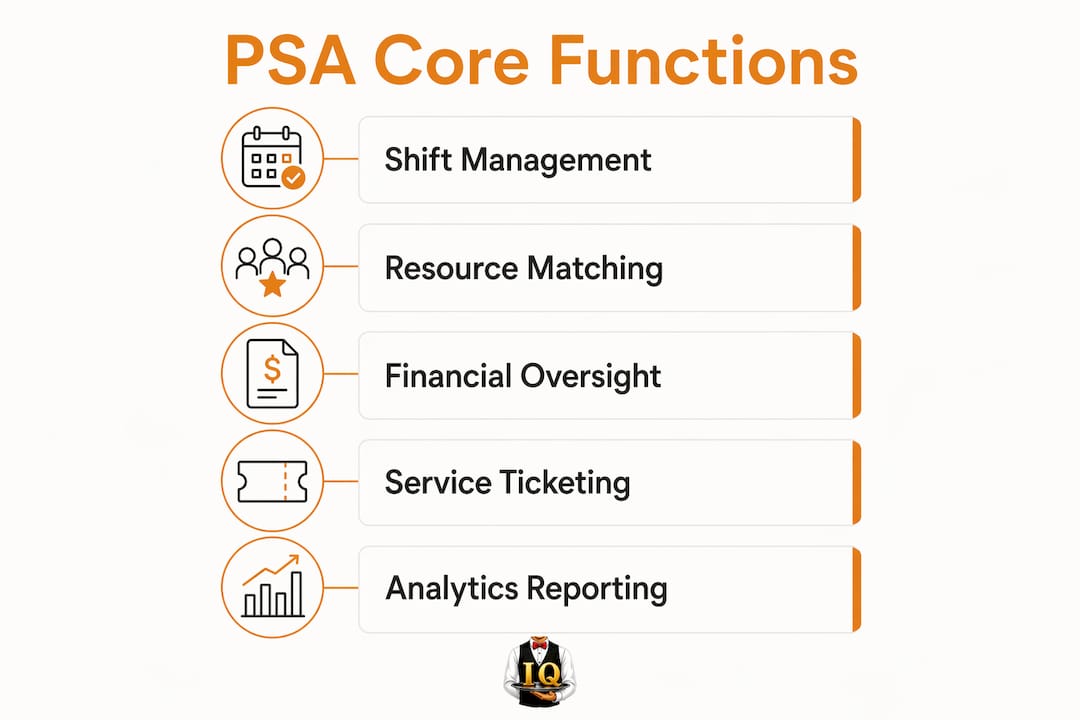
Reporting and analytics pull everything together. Managers get dashboards showing shift coverage rates, average tip income by server, and labor cost trends across locations, giving them the data to make staffing decisions based on facts rather than gut instinct.
Why do MSPs managing restaurant servers benefit from PSA systems?
The clearest benefit is time. When billing, scheduling, and client communication run through a single platform, the administrative load drops sharply, and managers can spend that recovered time on actual service quality.
Scheduling conflicts are one of the most common sources of friction in restaurant operations. A PSA system with real-time availability tracking and automated conflict detection catches double-bookings and understaffing before the shift starts, not after a server calls in sick at 4:00 PM.
Tip income visibility is where PSA tools genuinely separate themselves from generic HR software. Visibility into actual support costs and labor effort lets MSPs know exactly what each client account costs to service, rather than relying on estimates. For restaurant servers working variable hours with fluctuating tip income, that granularity matters for payroll accuracy and income verification.
Automation of billing and payroll removes the human error that plagues manual processes. A server's hours, tips, and wage adjustments feed directly into the billing cycle, and the invoice goes out without anyone manually compiling a spreadsheet. Client satisfaction follows naturally when service is consistent and billing is accurate.
What key features should you look for in a PSA tool for hospitality server workflows?
Not every PSA platform is built with restaurant operations in mind. The features that matter most for hospitality MSPs are specific, and the gap between a generic platform and a purpose-fit one shows up fast.
- Automated shift scheduling with conflict detection and availability matching
- Integrated tip and wage tracking that updates in real time as shifts close
- Centralized ticketing for guest requests, incident reports, and special event coordination
- Skill-based resource allocation so the right server handles the right section or event
- Analytics dashboards showing wage patterns, tip averages, and shift efficiency by location
- Integration with RMM and operational tools so technical alerts and business records stay in sync
The analytics piece deserves particular attention. A PSA's reporting module gives MSP leaders the data to course-correct service delivery, identify which restaurant accounts are consuming disproportionate resources, and adjust staffing contracts accordingly. That kind of insight is what separates a profitable MSP from one that is always reacting.
Pro Tip: When evaluating PSA platforms, ask vendors specifically about tip reconciliation workflows and multi-location account management. Generic platforms often handle one restaurant fine but break down when you are managing a group of ten.
Which PSA platforms do U.S. MSPs use in restaurant service operations?
Several established platforms have earned their place in MSP operations, each with a different strength profile. The leading PSA platforms recognized for multi-tenant management include ConnectWise PSA, Autotask PSA, Certinia Professional Services Cloud, Scoro, HaloPSA, and Kantata.
ConnectWise PSA is one of the most widely deployed platforms among U.S. MSPs. Its ticketing, billing, and contract management modules are mature, and its integration ecosystem covers most RMM tools in common use. For MSPs managing multiple restaurant clients, ConnectWise's multi-tenant architecture keeps account data cleanly separated.
Autotask PSA from Datto takes a similar approach but puts heavier emphasis on time tracking and billing automation. Restaurant MSPs that bill on a per-shift or per-event basis find its flexible billing rules useful for handling the variable nature of hospitality work.
Certinia Professional Services Cloud runs on the Salesforce platform, which makes it a natural fit for MSPs already using Salesforce CRM. Its project management depth is stronger than most competitors, though that depth comes with a steeper learning curve.
Scoro positions itself as an all-in-one work management platform. It covers quoting, project management, time tracking, and reporting in a single interface, which appeals to smaller MSPs that want fewer tools to manage.
HaloPSA has gained ground quickly among mid-size MSPs for its clean interface and flexible configuration. Its ticketing workflows are highly customizable, which matters when restaurant client requests do not fit neatly into standard IT service categories.
Kantata (formerly Mavenlink and Kimble combined) focuses on professional services firms with complex resource management needs. For MSPs running large restaurant groups with dozens of servers across multiple locations, Kantata's resource forecasting tools offer a level of planning depth the others do not match.
Each platform supports multi-tenant account management, meaning you can run separate billing, ticketing, and reporting environments for each restaurant client without data bleeding between accounts.
How do PSA and RMM tools work together for restaurant server management?
PSA and RMM tools are not competitors. They operate on different layers of the same operation, and the MSPs that treat them as a choice rather than a combination consistently run into problems.
PSA software handles the business layer: contracts, billing, ticketing, and client relationships. RMM handles the technical layer: monitoring, patching, remote access, and alerting. In a restaurant context, the RMM might flag a point-of-sale system going offline, while the PSA converts that alert into a billable service ticket, assigns a technician, and tracks resolution time against the client's service agreement.
Siloed tools increase operational risk and create missed billing. When an RMM alert fires and no one connects it to a PSA ticket, the work gets done but the invoice never goes out. That is lost revenue, and it happens daily in MSPs running disconnected systems.
The integration architecture matters. Three common approaches exist: native integrations between best-of-breed tools, unified platforms that combine both functions, and AI orchestration layers that sit across separate PSA and RMM systems. The AI orchestration approach has gained ground in 2026 because it fixes the handoff problems that native integrations leave unresolved, such as alert-to-ticket priority mapping and automatic time entry capture.
Pro Tip: Before adding an AI orchestration layer, audit your existing PSA-RMM handoffs for a week. Count how many RMM alerts generated no PSA ticket and how many tickets had no time entry. That number is your baseline for measuring improvement.
Common integration benefits include:
- Automated ticket creation from RMM alerts, with device context already attached
- Time entry suggestions generated from RMM actions, reducing manual logging
- Unified client records that stay in sync across both systems
- Enriched ticket context so technicians do not switch between platforms to assemble the picture
Tool sprawl directly impacts technician productivity and contract profitability. The fix is not always switching platforms. Adding an orchestration layer that bridges existing tools is almost always cheaper than migrating core systems.
How PSA tools define and shape restaurant server management in 2026
PSA software is best understood as the administrative nervous system for restaurant server operations. It does not replace the people doing the work; it removes the friction that slows them down and obscures what is actually happening across a client portfolio.
For an MSP managing restaurant servers, the PSA manages the entire service delivery lifecycle, from the moment a client submits a request to the moment an invoice is paid. Every step in between, including assignment, tracking, communication, and billing, runs through the same platform. That centralization is what makes the difference between an MSP that scales and one that hits a ceiling at a handful of clients.
The distinction from technical monitoring tools is worth stating plainly. An RMM tells you when something breaks. A PSA tells you what it cost to fix it, who fixed it, how long it took, and whether you billed for it. Restaurant server management needs both layers, but the PSA is where the business outcomes live.
What automation workflows do PSA tools enable in restaurant server management?
Automation is where PSA tools pay for themselves fastest. PSA automation reduces manual effort for scheduling and service tracking, freeing up managers and technicians to focus on work that actually requires human judgment.
The most impactful workflows in restaurant server management include:
- Automatic ticket creation from incoming client requests, with categorization and priority assignment handled by rules rather than a person
- Shift assignment automation based on availability, skill level, and client preferences, without a manager manually cross-referencing a spreadsheet
- Billing cycle automation that pulls time entries and tip data at shift close and generates invoices without manual compilation
- Escalation workflows that route unresolved tickets to senior staff after a defined time threshold, keeping SLAs intact
- Communication automation that sends clients status updates at defined intervals, reducing inbound "what's the status?" calls
The ticket lifecycle piece is particularly valuable for restaurant service contexts where requests come in fast and resolution windows are short. An automated workflow that assigns, tracks, and closes tickets without human intervention at each step handles volume that would overwhelm a manual process.
How do PSA tools give you visibility into server performance and incidents?
Visibility in restaurant server management means knowing, in real time, what every server on your roster is doing, what issues have been reported, and how quickly they are being resolved. PSA tools deliver that through centralized dashboards and integrated reporting.
When a guest incident is logged, the PSA captures the time, the server assigned, the resolution steps taken, and the outcome. Over time, that data surfaces patterns: which servers generate the most incident tickets, which shifts run the highest complaint rates, which restaurant locations have recurring service gaps. A PSA's analytics dashboard gives MSP leaders the data to act on those patterns rather than discover them in a quarterly review.
For performance reporting across multiple restaurant clients, the multi-tenant architecture of platforms like ConnectWise PSA and HaloPSA means each client sees only their own data while the MSP sees everything. That separation is what makes it possible to manage ten restaurant accounts without the reporting becoming a tangled mess.
Real-time visibility also supports SLA compliance. When a ticket is approaching its resolution deadline, the PSA flags it automatically, giving the assigned server or technician time to act before the breach rather than after.
How do PSA tools help you track profitability in restaurant server management?
Profitability tracking is where many MSPs discover they have been undercharging for years. Without a PSA, the cost of servicing a restaurant client is largely invisible. With one, every hour of labor, every incident resolved, and every shift covered maps directly to a client account.
Advanced PSA functionality goes beyond invoicing to provide profitability insights per service line and per client account. For restaurant MSPs operating on flat-fee contracts, that granularity reveals which accounts are profitable and which are consuming more resources than the contract covers. That is the data you need to renegotiate terms or restructure service tiers.
Linking technician time entries to specific tasks lets MSPs see where resource drains are occurring. A restaurant client that generates three times the average ticket volume at the same monthly rate is a contract problem, and the PSA surfaces it with numbers rather than anecdotes.
For individual restaurant servers, earnings tracking at the shift level gives both the server and the MSP a clear record of wages, tips, and hours. That record supports income verification, payroll audits, and financial planning in a way that a paper tip log never could.
Best practices for implementing PSA tools in restaurant server management operations
A PSA implementation that goes wrong usually fails for one of three reasons: the platform was not configured for the specific workflows of restaurant service delivery, staff were not trained before go-live, or the integration with existing tools was left incomplete.
Start by mapping your current workflows before touching the platform. Document how shifts are assigned today, how tips are recorded, how client requests are handled, and where billing errors most often occur. That map becomes your configuration guide.
Configure the PSA to match your actual billing model. Restaurant MSPs often use a mix of flat-fee contracts, per-event billing, and hourly rates across different clients. A PSA that is not configured to handle that mix will generate billing errors from day one.
Train staff on the ticketing system before anything else. The ticketing workflow is the part of the PSA that every server and manager touches daily. If they do not trust it, they will route around it, and the data quality collapses.
Integrate with your RMM and payroll systems before going live. A PSA running in isolation from your technical monitoring tools and payroll platform creates exactly the kind of data silos it was supposed to eliminate. The integration between PSA and RMM is where the operational value compounds.
Review your reporting configuration at the 30-day mark. The dashboards that seemed useful during setup often need adjustment once real data starts flowing. Build in a structured review to reconfigure reports based on what managers actually need to see.
What challenges do PSA tools face in restaurant server management, and how do you fix them?
The most common challenge is adoption. Restaurant servers and front-of-house managers are not IT professionals, and a PSA platform designed for a software development MSP can feel alien in a hospitality context. The fix is configuration, not replacement: simplify the interface, reduce the number of required fields, and build workflows that match how restaurant staff actually think about their work.
Data synchronization between PSA and RMM systems breaks in predictable ways. Client records drift out of sync, alert-to-ticket mappings become stale, and time entries go uncaptured. AI orchestration layers address these handoff failures more effectively than point-to-point integrations, particularly for MSPs managing multiple restaurant clients with different system configurations.
Contract misalignment is a subtler problem. When the PSA is configured with billing rules that do not match the actual service agreement, invoices come out wrong and client trust erodes. Audit every contract configuration at implementation and again at each contract renewal.
Cost is a real barrier for smaller restaurant MSPs. Enterprise PSA platforms carry licensing costs that do not make sense for a two-person operation managing three restaurant clients. In those cases, lighter platforms like Scoro or HaloPSA offer the core functionality at a price point that fits. For individual restaurant servers tracking their own earnings, purpose-built tools at a fraction of the cost of enterprise PSA software cover the income visibility gap without the overhead.
Finally, reporting that no one reads is a waste of configuration time. Build dashboards around the decisions managers actually make: staffing levels, tip averages by shift, incident resolution rates, and billing accuracy. If a report does not connect to a decision, cut it.
Key Takeaways
PSA tools are the business operations layer that makes restaurant server management scalable, profitable, and measurable for MSPs in 2026.
| Point | Details |
|---|---|
| PSA as the business layer | PSA tools handle contracts, billing, ticketing, and scheduling while RMM tools cover technical monitoring. |
| Profitability visibility | Linking labor time to client accounts reveals which restaurant contracts are profitable and which need renegotiation. |
| Integration is non-optional | Disconnected PSA and RMM systems cause missed billing and technician inefficiency; tight integration or AI orchestration fixes this. |
| Adoption drives value | PSA tools only deliver results when staff use them consistently; simplified workflows and targeted training determine success. |
| Purpose-fit tools matter | Platforms like ConnectWise PSA, HaloPSA, and Scoro each suit different MSP sizes and restaurant service models. |
Serveriq is built specifically for restaurant servers who need income visibility without the complexity of enterprise software. For $3 per month, you get shift-by-shift tip tracking, wage logging, and earnings reports that hold up for income verification, all managed through Chip, Serveriq's voice-activated assistant. If you are a server who wants to know exactly what you earned last month without digging through paper logs, start tracking today and see your earnings clearly for the first time.