
Remote server monitoring is the continuous, real-time observation of a restaurant server's earnings activity, shift data, and income patterns from any location, giving IT professionals and system administrators full visibility into how their team's financial tracking performs. For restaurant operations that depend on accurate tip reporting, hourly wage logging, and variable pay management, the role of remote server monitoring is to catch gaps, errors, and anomalies before they become costly problems. Serveriq applies this principle directly, giving restaurant managers and staff a platform to track income metrics with the same discipline that enterprise IT teams bring to uptime management. The stakes are real: when income data goes unmonitored, servers lose money and managers lose trust.
What are the key benefits of remote server monitoring for restaurants?
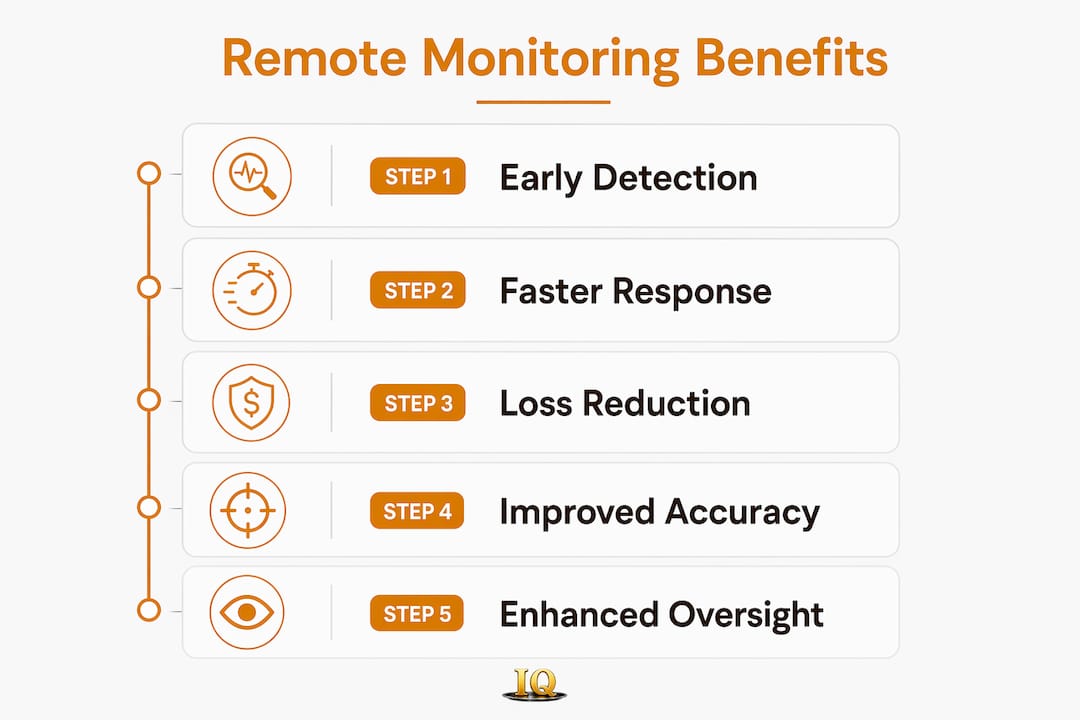
Remote monitoring of server earnings data delivers measurable value across three areas: early error detection, reduced financial loss, and stronger operational continuity.
Early detection of anomalies is the most immediate benefit. When a server's logged tips fall outside their normal range, or a shift entry goes missing entirely, a monitoring system flags it within minutes rather than days. Modern monitoring systems can trigger alerts within 30 seconds, reducing what could become hours of unresolved discrepancies down to under five minutes of response time. That speed matters when payroll runs weekly and errors compound fast.

Reduction in financial loss follows directly from faster detection. The cost of downtime for mid-size to large enterprises exceeds $300,000 per hour on average. While a restaurant's scale differs, the principle holds: unmonitored income gaps, missed tip entries, or unlogged shifts translate directly into lost earnings for servers and inaccurate records for managers. Proactive monitoring prevents those gaps from reaching payroll.
Operational continuity is the third pillar. When income tracking runs without interruption, servers can focus on their shifts instead of manually reconciling pay discrepancies at the end of the week. The importance of server monitoring in this context is less about technology and more about trust. Servers who know their earnings are tracked accurately perform with more confidence.
Additional benefits include:
- Consistent data quality across all shift types, including split shifts and double shifts
- Faster identification of pay discrepancies before they reach payroll processing
- Support for compliance with wage and tip reporting standards
- Clearer earnings patterns that help servers make informed financial decisions
Which metrics matter most for restaurant server income monitoring?
Effective income monitoring tracks the right data points at the right frequency. For restaurant servers, the critical metrics are tip amounts per shift, hourly wage entries, total pay per pay period, and shift duration accuracy. These are the equivalent of CPU utilization and memory usage in traditional IT monitoring. Each one tells a specific story about system health.
Setting alert thresholds requires real baseline data. Best practices recommend collecting 30 days of actual earnings data before configuring alerts, using the mean plus three standard deviations (mean + 3σ) as the threshold boundary. Applied to server income tracking, this means a server whose average nightly tips are $120 would trigger a review alert if a logged shift shows $0 or $400, both of which fall outside the normal range.
The table below shows how traditional IT monitoring metrics map to restaurant server income tracking:
| IT Monitoring Metric | Restaurant Server Equivalent | Alert Trigger Example |
|---|---|---|
| CPU utilization | Tip volume per shift | Tips logged at $0 on a busy Friday night |
| Memory usage | Shift log completeness | Missing hourly wage entry for a 6-hour shift |
| Network traffic | Pay period total activity | No entries logged for 3 consecutive days |
| SSL expiry checks | Payroll submission deadlines | Pay period closes with unconfirmed entries |
| DNS propagation | Data sync between app and payroll | Shift data not reflected in weekly report |
SSL expiry and DNS propagation failures cause about 20% of self-hosted downtime in restaurant-like environments. The parallel for income tracking is data sync failures, where shifts logged in the app do not appear in the weekly earnings report. Catching these early prevents payroll errors.
Pro Tip: Run a weekly 30-minute audit of your income entries during the first 90 days of using any tracking system. Alert fatigue and false positives are most common in this window, and early calibration saves significant time later.
How does modern monitoring transform incident response for restaurant teams?
Server monitoring has evolved from a convenience to a business continuity necessity. For restaurant IT teams managing income tracking platforms, this evolution means building a response pipeline, not just a data log. When an anomaly appears, the system should route the alert, provide context, and point toward a resolution, all without requiring a manager to manually investigate from scratch.
The steps that define a strong incident response pipeline for restaurant server income monitoring are:
- Detect the anomaly. The system flags a shift entry that falls outside the established threshold, such as a tip amount that is three times the server's 30-day average.
- Route the alert. The alert goes to the right person, whether that is the server, the shift manager, or the payroll administrator, based on the type of discrepancy.
- Provide context. Effective alerts include links to runbooks with diagnostic steps. For income tracking, this means the alert shows the server's recent earnings history alongside the flagged entry.
- Escalate if unresolved. If the flagged entry is not reviewed within a set window, the alert escalates to a supervisor. This mirrors the escalation policies used in enterprise IT on-call systems.
- Close the loop. Once the entry is corrected or confirmed, the system logs the resolution. This creates an audit trail that supports compliance and future threshold calibration.
Monitoring's primary goal is to reduce guesswork for on-call engineers during incidents. Applied to restaurant income tracking, this means a manager reviewing a flagged entry should have all the context needed to make a decision in under two minutes, not two hours.
Pro Tip: Link every alert type to a specific resolution action. "Tips logged at $0" should automatically surface the server's last three shift entries and the shift schedule for that date. Context cuts resolution time in half.
Combining internal data from the app with external verification, such as cross-referencing POS system records, mirrors the hybrid monitoring approach that IT teams use when pairing internal agents with external synthetic probes. Both methods reduce blind spots.
What practical steps do restaurant IT teams take to implement income monitoring?
Implementation follows a clear sequence. Skipping steps, especially baseline collection and alert calibration, is the most common reason monitoring systems produce noise instead of signal.
The core implementation steps for restaurant server income monitoring are:
- Deploy the tracking platform first. Serveriq's $3 per month platform gives servers a dedicated tool for logging tips, hourly wages, and variable pay. The virtual assistant Chip accepts voice commands, which reduces entry friction during busy shifts.
- Collect 30 days of baseline data before configuring any alerts. This period establishes what normal looks like for each server, accounting for differences between weekday and weekend earning patterns.
- Configure alerts based on baselines, not assumptions. A server who averages $80 in tips on Tuesday nights needs a different alert threshold than one who averages $200 on Saturday nights.
- Assign alert ownership. Each alert type should have a named reviewer. Unowned alerts get ignored. Treating monitoring as part of incident handling means every alert has a responsible party and a resolution path.
- Conduct weekly audits for the first 90 days. Alert fatigue is most common in the first 90 days of deployment. Weekly 30-minute reviews of alert volume and false positives keep the system calibrated.
- Use centralized dashboards for capacity planning. Serveriq's detailed earnings reports give managers a consolidated view of team income patterns, which supports scheduling decisions and identifies which shifts generate the most revenue per server.
Static thresholds are reactive. Capacity-forecasting alerts, which predict when a threshold will be crossed rather than reacting after the fact, give managers hours or even days of lead time. For restaurant income tracking, this means identifying a server whose earnings have trended downward for three consecutive weeks before the issue reaches payroll.
A well-maintained server management workflow treats monitoring as an ongoing practice, not a one-time setup. Schedule quarterly reviews of your alert thresholds as your team's earning patterns shift with seasons and staffing changes.
Key Takeaways
Remote server monitoring for restaurants works best when it combines real baseline data, calibrated alerts, and a clear incident response pipeline to protect server earnings and operational accuracy.
| Point | Details |
|---|---|
| Baseline before alerting | Collect 30 days of earnings data before setting any alert thresholds. |
| Mean + 3σ threshold method | Use statistical baselines to set alert boundaries that reflect each server's actual earning patterns. |
| Assign alert ownership | Every alert type needs a named reviewer and a resolution path to avoid ignored notifications. |
| Audit weekly for 90 days | Alert fatigue peaks early; weekly reviews keep the system accurate and reduce false positives. |
| Hybrid monitoring reduces blind spots | Combine in-app data with external verification, such as POS records, for complete income visibility. |
What I've learned from watching restaurant teams skip the baseline step
The single most common mistake I see restaurant IT teams make is configuring alerts on day one. They set a threshold of "flag anything under $50 in tips" without knowing that half their servers work Tuesday lunch shifts where $30 is perfectly normal. The result is a flood of false positives that trains everyone to ignore the alerts entirely.
The mean + 3σ method sounds technical, but it is just a disciplined way of asking: what does normal actually look like for this person, on this shift, at this time of year? That question takes 30 days to answer properly. Skipping it costs far more than 30 days of manual review later.
I have also seen the opposite problem: teams that collect the data but never act on it. A dashboard full of earnings reports is not monitoring. Monitoring requires a response pipeline. When an alert fires, someone needs to know what to do within two minutes. If that path is not defined before the alert fires, the alert is just noise.
The future of income monitoring for restaurant servers will involve more predictive signals, not just reactive ones. Knowing that a server's earnings have trended down for three weeks is more valuable than knowing their last shift was low. The tools to do this already exist. The discipline to use them consistently is what separates teams that benefit from monitoring from teams that just have it installed.
— sadler
How Serveriq supports restaurant teams with income monitoring
Restaurant servers and bartenders manage variable income that changes shift by shift. Serveriq gives them a dedicated platform to track tips, hourly wages, and all forms of pay for $3 per month.
The virtual assistant Chip logs shifts and updates earnings through voice commands, which removes the friction of manual entry after a long shift. Detailed earnings reports show patterns over time, helping servers understand which shifts pay best and giving managers the data they need for scheduling decisions. For teams ready to move from guesswork to structured income visibility, Serveriq's subscription is the most direct path to consistent, accurate earnings tracking built specifically for the restaurant industry.
FAQ
What is the role of remote server monitoring for restaurant staff?
Remote server monitoring tracks a restaurant server's earnings data in real time, flagging missing entries, unusual tip amounts, and pay discrepancies before they reach payroll. It gives both servers and managers continuous visibility into income accuracy.
How do you set effective alert thresholds for income monitoring?
Collect 30 days of actual earnings data first, then set thresholds using the mean plus three standard deviations. This method accounts for natural variation between shifts and prevents false positives from overwhelming the review process.
What are the best practices for server monitoring in restaurants?
The most effective practices are baseline collection before alert configuration, weekly audits during the first 90 days, named alert ownership, and linking each alert type to a specific resolution action. These steps mirror enterprise IT monitoring discipline applied to income tracking.
How does Serveriq help with remote income monitoring?
Serveriq provides a $3 per month earnings tracking platform with voice-command logging through its virtual assistant Chip, detailed shift reports, and pattern analysis. It is built specifically for servers and bartenders managing variable, tip-based income.
Why does alert fatigue happen and how do you prevent it?
Alert fatigue occurs when thresholds are set without baseline data, generating too many false positives for reviewers to take seriously. Weekly 30-minute audits during the first 90 days of deployment recalibrate the system and reduce noise before it becomes a habit to ignore alerts.